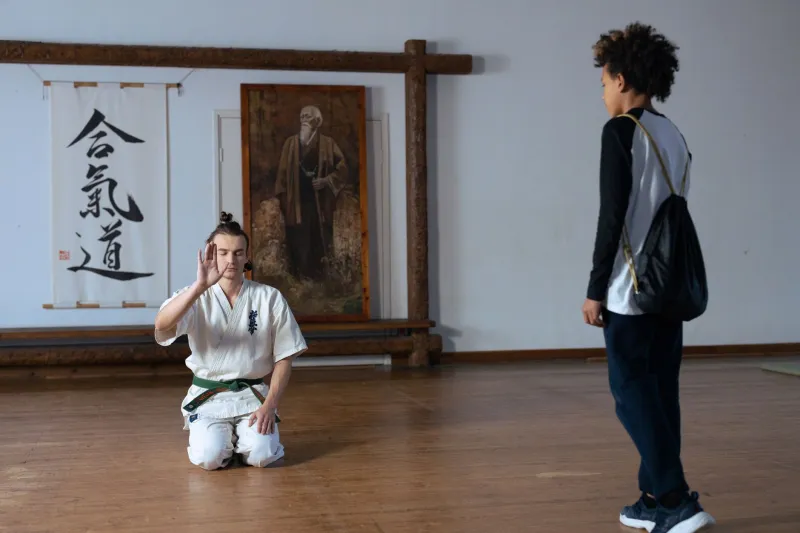
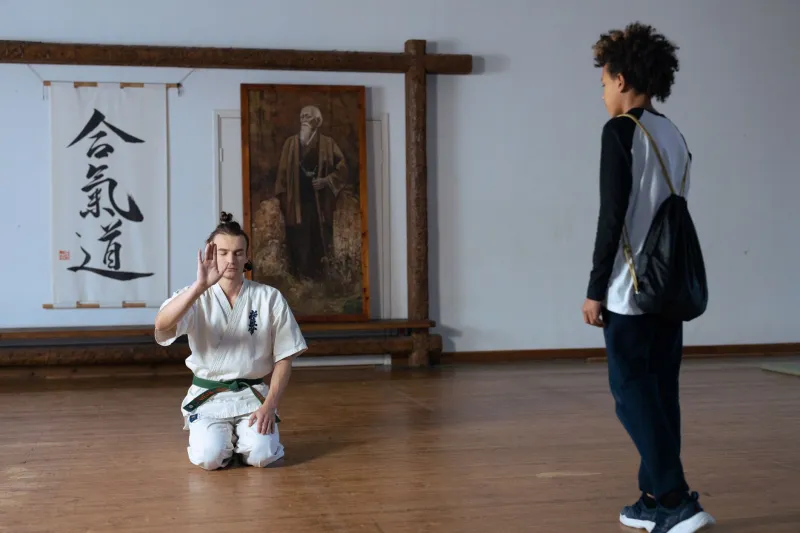
Trained for the Unexpected: How Aikido Builds the Mental Architecture for Improvisation Under Pressure
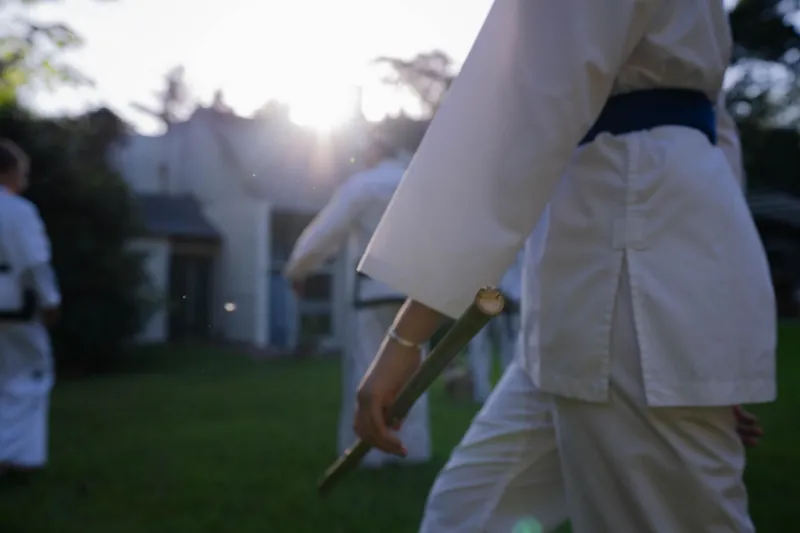
There is a moment familiar to every serious aikido practitioner—a moment when a training partner moves differently than anticipated, when the expected angle of attack shifts mid-execution, and the prepared technique simply ceases to apply. For the novice, this moment produces hesitation, frustration, or a rigid attempt to force a failing response. For the experienced aikidoka, something else happens entirely: the body and mind pivot without panic, reading what is actually present rather than what was expected, and a new path opens.
This is not instinct in the conventional sense. It is a cultivated capacity—one that neuroscience is beginning to explain with increasing precision, and one that carries consequences far beyond the dojo mat.
The Problem with Rigid Systems
Most structured training environments—whether in martial arts, athletics, or professional disciplines—reward the reliable execution of predetermined responses. Repetition builds competence, and competence builds confidence. There is genuine value in this approach. However, it contains a structural vulnerability: when reality deviates from the scenario the practitioner trained for, the entire framework can collapse.
Cognitive scientists refer to this as "script failure"—the moment when the mental program an individual has rehearsed no longer matches the incoming data. In high-stakes environments, script failure is not exceptional. It is routine. Emergency responders encounter it constantly. Business leaders face it in negotiations and crises. Parents encounter it in conversations they never anticipated having.
Aikido, by design, trains practitioners to expect and accommodate script failure rather than resist it.
Reading Energy, Not Memorizing Responses
The foundational principle of aiki—the harmonization of energies—requires the practitioner to perceive and work with what is actually moving, not what was theoretically supposed to move. This distinction is more profound than it may initially appear.
In many martial disciplines, a given attack corresponds to a specific counter. The practitioner trains the counter until it becomes automatic, then applies it when the corresponding trigger appears. Aikido's approach is structurally different. While foundational techniques are certainly practiced with repetition, the deeper training objective is sensitivity: the ability to perceive the direction, momentum, and intention encoded in an opponent's movement and to respond to that, in real time, rather than to a category of movement.
This requires the nervous system to remain perpetually open to incoming information rather than closing around a prepared answer. Neurologically, this corresponds to what researchers describe as a state of heightened "bottom-up" processing—a mode in which sensory input is prioritized over top-down cognitive predictions. Experienced meditators and trained musicians show similar neural signatures, but aikido develops it through physical, relational, and often unpredictable interaction with another human being.
What Happens in the Brain
Studies in motor neuroscience and cognitive flexibility offer a useful framework for understanding what aikido training produces over time. The prefrontal cortex—responsible for executive function, planning, and the suppression of impulsive responses—must learn to remain engaged without becoming rigid. The cerebellum, which manages the timing and coordination of movement, becomes increasingly sensitive to subtle deviations from expected patterns.
Perhaps most significantly, regular exposure to unpredictable physical interaction appears to reduce the threat response associated with uncertainty. When the nervous system repeatedly encounters situations that deviate from expectation and discovers that it can navigate them successfully, it recalibrates its baseline threat assessment. The unexpected becomes less alarming—not because the practitioner has grown reckless, but because the brain has accumulated evidence of its own adaptive capacity.
This neurological recalibration is precisely what makes experienced aikidoka appear calm in circumstances that would unsettle less-trained individuals.
Improvisation as a Trained Skill
The word "improvisation" often carries connotations of spontaneity and raw talent—as though the ability to respond creatively in the moment is simply a gift some people possess. Research in both performance psychology and organizational behavior tells a more nuanced story. Effective improvisation is not the absence of training; it is the product of training that deliberately builds flexibility alongside competence.
Jazz musicians, for example, do not improvise from ignorance. They improvise from deep familiarity with harmonic structures, rhythmic vocabularies, and the listening habits required to respond to fellow musicians in real time. Their improvisation is disciplined rather than random.
Aikido produces an analogous result in the physical and interpersonal domain. The practitioner who has spent years learning to feel and redirect force does not become formless—they become fluently adaptive. The techniques they have practiced become a vocabulary rather than a script, available for recombination as circumstances demand.
Applications Beyond the Dojo
The transfer of this capacity to non-martial contexts is where the broader significance of aikido training becomes apparent.
In emergency response and healthcare, professionals who train in adaptive physical disciplines report a measurable reduction in cognitive freeze during high-stakes incidents. The body's learned capacity to stay present and responsive under physical pressure appears to generalize to situations involving time pressure, incomplete information, and high emotional stakes. Several hospital systems and first-responder training programs across the United States have begun exploring somatic training—including martial arts—as a supplement to conventional crisis preparation for precisely this reason.
In business leadership, the ability to read a room, detect the actual direction of a conversation rather than the expected one, and redirect without imposing a predetermined agenda is among the most valued and least trainable executive competencies. Aikido's relational training—conducted in close physical contact with another person whose responses cannot be scripted—builds exactly this perceptual sensitivity. Leaders who have trained seriously in the art frequently describe negotiations and conflict situations in terms that echo dojo language: finding the opening, moving with rather than against, maintaining center under pressure.
In personal crisis, the psychological dividend of aikido's adaptive training may be most immediately felt. When a significant relationship, career path, or life plan suddenly collapses, the individual whose nervous system has been trained to navigate script failure without panic possesses a genuine advantage. The capacity to remain present, assess what is actually happening rather than what was supposed to happen, and identify a workable path forward is not automatic in most people. In aikido practitioners who have trained with genuine depth, it frequently is.
The Paradox at the Center
There is something genuinely counterintuitive in aikido's approach to preparedness: the art trains practitioners to handle the unexpected by releasing attachment to specific expectations. This is not passivity. It requires extraordinary discipline—the discipline to remain fully present and responsive rather than retreating into a predetermined plan.
For Americans accustomed to performance frameworks that emphasize measurable outcomes and reproducible methods, this can initially feel disorienting. Progress in aikido does not always look like the accumulation of techniques. It often looks like the quiet expansion of one's capacity to remain functional when familiar frameworks fail.
That capacity, as both neuroscience and lived experience confirm, is among the most durable and transferable skills a practitioner can develop. The mat is merely where the training begins.
Aikido Path provides resources for practitioners at every stage of the journey. Explore our Training Science section for further reading on the physiological and psychological dimensions of aikido practice.