The Quiet Accelerator: How Ego Dissolution in Aikido Training Unlocks Skill Progression That Competitive Arts Rarely Achieve
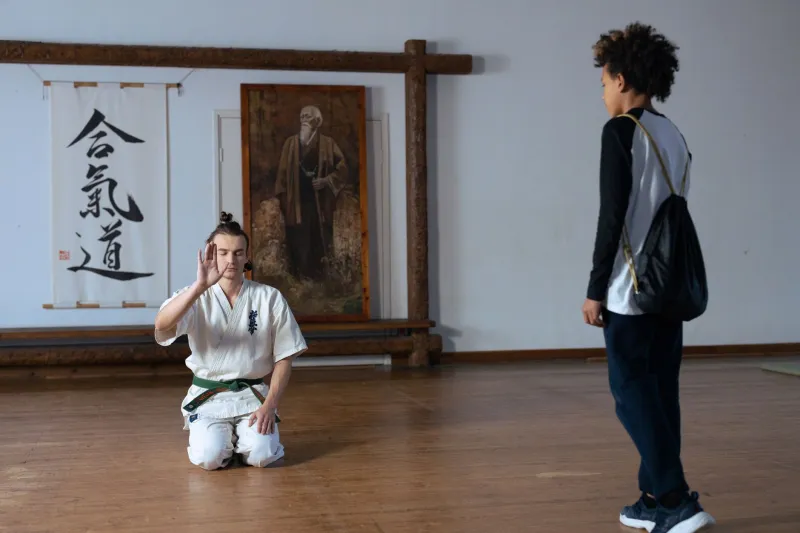
There is a moment familiar to nearly every new aikido student — a moment that rarely occurs in boxing gyms or wrestling rooms. It arrives when the instructor asks you to stop trying to make a technique work and simply allow it to happen. For many Americans raised in a culture that prizes effort, assertion, and competitive drive, the instruction feels not just unusual but almost philosophically threatening. Yet practitioners who move through that discomfort consistently report something unexpected on the other side: they get better, faster.
This is the central paradox that distinguishes aikido's learning environment from that of most competitive martial arts. Where sports like Brazilian jiu-jitsu or Muay Thai reward the student who pushes hardest against resistance, aikido systematically dismantles the instinct to push at all. And the consequences for skill development, it turns out, are profound.
What the Nervous System Actually Needs to Learn
Motor learning researchers have long understood that the acquisition of complex physical skills depends heavily on a learner's capacity to receive and process feedback without interference. Dr. Timothy Lee of McMaster University, whose work on contextual interference and practice variability has influenced sports science broadly, notes that learners who approach skill acquisition with reduced performance anxiety tend to encode movement patterns more durably than those under high evaluative pressure.
In practical terms, this means that a student who fears looking incompetent — whose ego is actively monitoring every repetition for signs of failure — is neurologically less available to absorb technical information. The prefrontal cortex, engaged in self-monitoring and social evaluation, competes with the motor cortex and cerebellum for cognitive resources. Learning is not impossible under these conditions, but it is measurably slower and the resulting patterns are more brittle under stress.
Aikido training addresses this problem structurally rather than leaving it to the individual student to manage. The cooperative training model, in which uke (the partner delivering the attack) actively supports nage (the person executing the technique), removes the competitive evaluation loop almost entirely. There is no scoreboard. There is no tap-out that signals defeat. There is, instead, an ongoing invitation to feel what is working and adjust.
The Role of the Uke Relationship
In most competitive martial arts, a training partner's primary function is adversarial — to resist, counter, and expose weakness. The value is genuine; pressure testing is essential to any serious martial education. But the adversarial model also activates exactly the self-protective instincts that slow learning. Students tense, compensate, and develop habits designed to survive the moment rather than refine the movement.
The uke relationship in aikido operates on a different logic. A skilled uke provides honest feedback through the body — neither collapsing artificially nor rigidly resisting — while maintaining a shared commitment to the training process. Long-term practitioners describe this as a kind of kinesthetic conversation, one that only becomes possible when both parties have released the need to win the exchange.
Sensei Patricia Hendricks, one of the senior instructors at Aikido of San Jose and a student of Mitsugi Saotome Shihan, has described this dynamic in seminar settings as "listening with your whole body." The capacity to listen, she notes, requires first becoming quiet inside — which is precisely what ego dissolution accomplishes.
Plateau-Breaking and the Surrender Mechanism
Every martial artist encounters plateaus: extended periods where technical progress stalls despite continued training. In competitive arts, the standard prescription is to train harder, compete more frequently, or seek out more challenging opponents. These strategies work, but they work slowly, and they often entrench compensatory habits before genuine refinement occurs.
Aikido practitioners and their instructors report a different plateau-breaking mechanism. When a student genuinely relinquishes the need to perform correctly — when the internal pressure to demonstrate competence is released — technique frequently reorganizes itself almost spontaneously. Instructors at dojos across the United States describe witnessing this regularly: a student who has been struggling with a particular throw for months suddenly executes it with unexpected fluidity after a conversation that had nothing to do with the mechanics of the throw and everything to do with their relationship to failure.
This is not mysticism. It reflects a well-documented phenomenon in motor learning called implicit acquisition — the process by which the nervous system assembles complex movement patterns below the threshold of conscious attention. Implicit learning is faster and produces more robust motor programs than explicit, consciously directed learning. Ego investment, with its constant stream of self-evaluative thought, is precisely the kind of conscious interference that suppresses implicit acquisition. Releasing that investment clears the channel.
Retention Rates and the Long Game
Skill retention — how well a practitioner maintains technical competence over time, particularly during periods of reduced training — is another domain where aikido's psychological model appears to confer advantages. Research on motor memory consolidation suggests that skills learned under low-anxiety conditions, with high variability and cooperative feedback, tend to be retained more durably than skills acquired under high competitive pressure.
This may explain an observation common among American aikido communities: practitioners who train consistently for five or more years demonstrate a remarkable ability to return to technical proficiency after interruptions — injury recovery, life transitions, career demands — that would significantly erode competence in sports requiring constant competitive conditioning. The movement patterns, absorbed through thousands of low-ego repetitions, appear to consolidate deeply.
Practical Exercises for Ego Release in Training
For practitioners looking to deliberately accelerate their development through this mechanism, several training approaches have proven effective in dojo settings across the country.
Deliberate failure practice. Choose a technique you find difficult and commit to performing it incorrectly for an entire training session — not carelessly, but with full attention, simply removing the goal of success. The absence of a performance target frequently allows the nervous system to find its own corrections.
Verbal narration during practice. With a trusted training partner, narrate what you are feeling rather than what you are trying to do. This shifts attention from outcome to sensation, which is precisely where productive motor learning occurs.
Role reversal reflection. After serving as uke, spend two minutes describing to your partner what you felt in your body as nage executed the technique. This builds proprioceptive vocabulary and makes future self-correction more precise.
Breath-first training. Begin each technique by establishing full, relaxed breathing before initiating movement. The ego's interference is almost always accompanied by breath-holding or shallow breathing. Normalizing breath normalizes the internal environment for learning.
The Deeper Implication
Aikido's founder, Morihei Ueshiba, spoke of training as a process of polishing the spirit rather than accumulating technique. American practitioners sometimes receive this language skeptically, accustomed as they are to measurable, demonstrable progress. But the science of motor learning offers a translation that requires no leap of faith: the conditions Ueshiba described as spiritual refinement are, in functional terms, the conditions most favorable to deep and durable skill acquisition.
The paradox resolves itself under examination. Surrendering the ego is not a sacrifice made for philosophical reasons at the expense of technical development. It is, in fact, the most technically efficient choice a practitioner can make. The path of least resistance, in aikido as in learning science, turns out to be the fastest path forward.