Releasing the Grip: What Aikido Teaches Us About Power Through Acceptance in High-Stakes Moments
There is a moment in early aikido training that confounds nearly every newcomer. An instructor invites a student to resist — to plant their feet, tighten their muscles, and refuse to be moved. The student braces. The instructor barely seems to try. And yet the student moves, often in a direction they never anticipated. The lesson embedded in that moment is not about physical strength. It is about something far more unsettling: the idea that the act of gripping tightly may be precisely what makes you vulnerable.
This principle sits at the center of aikido's philosophical architecture, and its implications extend well beyond the training mat. Practitioners who have spent years absorbing this teaching — and researchers who study human performance under pressure — are increasingly pointing to a shared conclusion: the compulsive need to control outcomes in high-stress situations is not a strength. It is, in many cases, a liability.
The Physiology of the Control Reflex
When human beings encounter a threatening situation, the autonomic nervous system initiates a cascade of responses designed for immediate survival. Muscles tighten. Attention narrows. Cognitive flexibility diminishes. This is the body's ancient crisis protocol, and in genuinely dangerous physical situations, it has its place.
The problem is that modern stressors — a high-stakes negotiation, a medical emergency, a sudden organizational crisis — rarely benefit from the same rigid, tunnel-vision response. Sports psychologists refer to the phenomenon of "paralysis by analysis" and "choking," both of which are associated with excessive self-monitoring and an overcorrection toward conscious control. Dr. Sian Beilock's widely cited research at the University of Chicago demonstrated that skilled performers frequently underperform when they think too deliberately about what they are doing. The very act of trying harder, in a certain sense, gets in the way.
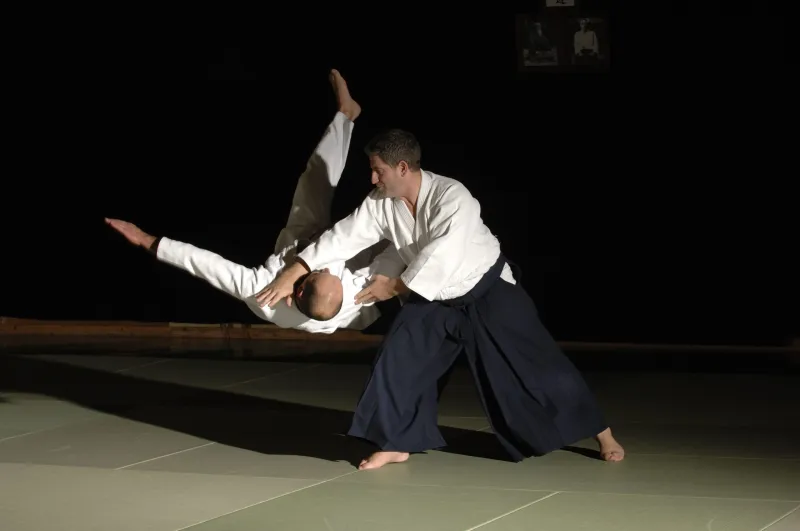
Aikido practitioners encounter this paradox on their first day of practice. Ukemi — the art of falling and receiving technique — cannot be executed well through muscular resistance. Students who attempt to stop a throw by stiffening discover quickly that rigidity amplifies impact rather than reducing it. The practitioner who relaxes, extends awareness, and moves with the technique lands safely. The one who fights it does not.
Blending as a Decision-Making Model
The aikido concept of irimi-tenkan — entering and turning — describes a physical pattern in which the practitioner steps into an attack rather than retreating from it, then redirects the force rather than absorbing it directly. The movement requires a practitioner to first accept the reality of what is happening before responding to it. There is no useful action available to someone who is busy denying that an attack has occurred.
This maps onto crisis decision-making in ways that practitioners across demanding American professions find immediately recognizable. Emergency room nurses, military officers, and crisis negotiators who have trained in aikido frequently describe a similar cognitive shift: the ability to acknowledge a situation fully — without catastrophizing or minimizing — before selecting a response.
"When you stop fighting the fact that something bad is happening, you free up enormous mental resources," said one long-term practitioner who works as a crisis intervention specialist in the Pacific Northwest. "Aikido trained me to treat incoming force as information rather than as a threat to be overcome. That reframe changes everything about how I respond."
This is not passive acceptance. Aikido is not a philosophy of resignation. It is, rather, a discipline of accurate perception followed by deliberate response — a sequence that is systematically disrupted when a practitioner is consumed by the need to impose a predetermined outcome.
Anxiety, Anticipation, and the Illusion of Control
Anxiety research consistently identifies one of its core features as an orientation toward the future — specifically, an attempt to mentally rehearse and prevent negative outcomes before they occur. The anxious mind works overtime to secure control over events that have not yet happened, and in doing so, it exhausts cognitive and emotional resources that would be better deployed in the present moment.
Aikido training is, in a practical sense, a sustained exercise in present-moment engagement. Every technique demands accurate reading of what is actually happening — the precise angle of a partner's movement, the distribution of their weight, the timing of a shift in momentum. Practitioners who are mentally rehearsing what they wish would happen instead of attending to what is happening are consistently outpaced by those who are simply present.
Sports psychologists working with American athletes in high-pressure competitive environments have begun drawing on mindfulness-based frameworks that share significant conceptual territory with aikido's approach. The goal in both contexts is the same: to cultivate a quality of attentive, non-reactive awareness that allows an individual to respond to conditions as they exist rather than as they fear or wish them to be.
When Letting Go Is the Decisive Act
The hardest lesson in aikido — and arguably the most transferable one — is that releasing control over a situation is not the same as abandoning responsibility for it. The practitioner who blends with an attack rather than opposing it has not given up. They have chosen a more sophisticated form of engagement.
In organizational leadership, in parenting under pressure, in emergency response, and in the management of personal health crises, this distinction matters enormously. The executive who insists on micromanaging every variable of a collapsing project frequently accelerates its failure. The parent who meets a teenager's distress with rigid demands typically deepens the conflict. The individual who responds to a medical diagnosis by furiously attempting to control every variable of their treatment often compounds their anxiety without improving their outcomes.
What aikido offers — through years of physical practice, not merely conceptual exposure — is a trained intuition for the moment when release becomes the most powerful available option. That intuition cannot be installed through a weekend seminar. It is built through repetition, through the patient accumulation of experience on the mat, through the gradual internalization of a principle that runs counter to most of what American culture celebrates about strength and success.
Building a Different Kind of Resilience
The practitioners who seem to benefit most from aikido's psychological dimensions are not those who come to the art already calm and centered. They are, often, the ones who arrive tightly wound — competitive, achievement-oriented individuals who discover, with considerable surprise, that the discipline they expected to make them more forceful is instead teaching them to be more fluid.
That fluidity, it turns out, is not a softening of capacity. It is an expansion of it. The practitioner who can blend with force rather than only opposing it has access to a wider range of responses in any high-pressure situation. They are not choosing weakness over strength. They are choosing precision over brute effort — and, in doing so, they are discovering that the grip they released was never what was keeping them safe to begin with.