Built to Last: How Aikido's Structural Principles Keep Practitioners Training for Life
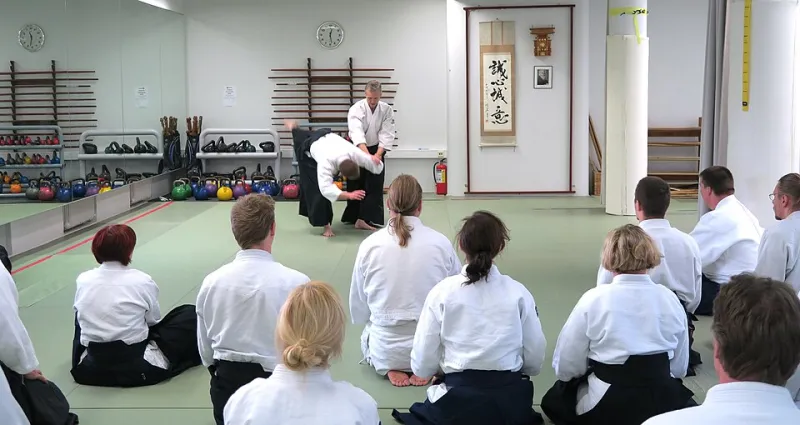
Among the many distinctions that set aikido apart from other martial arts, one of the most underappreciated is its remarkable record of practitioner longevity. Walk into an established American dojo on any given evening and you are likely to find students in their fifties, sixties, and even seventies training alongside younger practitioners — not as a curiosity, but as a natural expression of how the art is designed. That longevity is not accidental. It flows directly from aikido's rigorous attention to structural alignment and biomechanically efficient movement.
Understanding why this matters requires a brief look at how injuries actually occur in athletic and martial training contexts — and why aikido's foundational principles address those causes at their root.
How Athletic Injuries Happen: The Underlying Mechanics
The vast majority of training-related injuries fall into two broad categories: acute trauma from sudden impact or overextension, and cumulative damage from repetitive stress applied to joints and connective tissue in suboptimal positions. The latter category — repetitive strain injuries, tendinitis, joint degradation, and stress fractures — accounts for an enormous share of long-term athletic disability, particularly in disciplines that demand high-volume practice over many years.
What makes repetitive stress injuries so insidious is that they rarely announce themselves dramatically. Instead, they accumulate quietly, session after session, as small structural inefficiencies compound over time. A shoulder held slightly out of alignment during thousands of throws, a knee torqued fractionally inward during repeated footwork patterns — these micro-stresses add up. By the time symptoms appear, the underlying damage may already be significant.
Aikido's training methodology addresses this problem not by avoiding stress but by distributing it intelligently through the body's strongest structural pathways.
Centerline Integrity and the Architecture of Safe Movement
At the heart of aikido's biomechanical approach is the concept of center — referred to in Japanese as hara or seika tanden — the body's functional gravitational center located in the lower abdomen. Aikido technique is organized around maintaining integrity at this center and extending force outward from it through properly aligned limbs.
From an anatomical standpoint, this principle maps directly onto what sports medicine professionals describe as kinetic chain efficiency. When force originates from the core and travels through properly stacked joints — hips over knees, shoulders over hips, wrists aligned with forearms — each segment of the body handles only the load it is structurally designed to bear. When that chain breaks down, peripheral joints absorb forces they were never meant to sustain.
In practical training terms, an aikido instructor correcting a student's posture is not merely enforcing aesthetic convention. They are redirecting potentially injurious force patterns before they become habitual.
Joint Protection Through Circular Mechanics
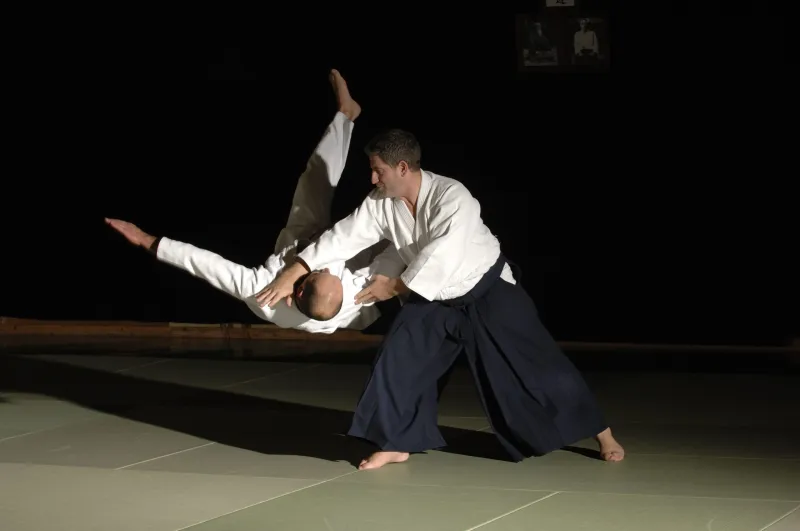
Aikido's characteristic circular and spiral movement patterns serve a specific biomechanical function that is frequently misunderstood by observers unfamiliar with the art. Rather than meeting force with direct linear resistance — a pattern that concentrates stress at the point of contact — aikido redirects incoming energy along curved pathways that distribute load across larger muscle groups and longer lever systems.
This has direct implications for joint protection. The wrist, elbow, and shoulder joints are among the most commonly injured structures in martial arts training. In disciplines that rely heavily on blocking, striking, and direct grappling resistance, these joints routinely absorb sudden compressive or shearing forces. Aikido's redirection model substantially reduces peak force at these vulnerable structures.
The ukemi (falling) practice that is central to aikido training provides an additional layer of protection. Learning to receive technique safely — distributing impact across the entire body surface rather than catching it on a single joint or extremity — is itself an injury-prevention discipline with applications well beyond the mat. Many long-term aikido practitioners report that their ukemi training has protected them during accidental falls in everyday life.
Posture as Preventive Medicine: The Spine and Hip Complex
Lower back pain is among the most prevalent musculoskeletal complaints in the United States, affecting an estimated 80 percent of Americans at some point in their lives. Much of this burden originates from habitual postural patterns that load the lumbar spine inefficiently.
Aikido training directly confronts these patterns. The art's characteristic upright posture — spine extended, pelvis neutrally positioned, weight distributed evenly through the feet — is not merely a martial stance. It is a postural template that, practiced consistently over years, can counteract the forward-head, rounded-shoulder positions that modern sedentary life tends to produce.
The hip-centered movement patterns that generate power in aikido techniques simultaneously strengthen the deep stabilizing muscles of the pelvis and lumbar region. Students who train consistently often report significant reductions in chronic back discomfort — a finding that aligns with broader research on the therapeutic benefits of movement arts that emphasize postural awareness.
Age-Appropriate Training and the Wisdom of Gradual Progression
One of the most pragmatic injury-prevention features of well-structured aikido programs is their emphasis on gradual, progressive skill development. Unlike sports that demand peak physical output early in a practitioner's career, aikido's technical complexity rewards patience and accumulated experience. This creates a training culture in which pushing beyond one's current capacity is actively discouraged rather than celebrated.
For older practitioners — a significant and growing demographic in American dojos — this philosophy is particularly valuable. The connective tissue changes that accompany aging mean that recovery from training stress takes longer and the consequences of overtraining are more severe. A dojo culture that values technical refinement over physical intensity allows older students to continue developing their skills while respecting their body's genuine needs.
For younger practitioners, the same principle establishes sound habits early. Learning to train with precision rather than force, to feel and respond to structural feedback rather than overriding it, creates a neurological and physical foundation that serves practitioners throughout their entire career.
Practical Guidance for Training Injury-Free
The biomechanical principles described above translate into several concrete practices that any aikido student can prioritize regardless of their current level.
Attend to your posture before intensity. In every technique, establish correct skeletal alignment before adding speed or force. A movement executed perfectly at half speed builds the neural pathways that will protect you when training becomes more vigorous.
Communicate with your training partners. Aikido's partner-based format means that injury prevention is a shared responsibility. Establish clear signals for discomfort, respect your partner's physical limits, and develop the habit of checking in after techniques that involve joint manipulation.
Invest in your ukemi. Falling practice is not a preliminary exercise to be rushed through on the way to "real" technique. It is a foundational skill set that will protect you in training and in life. Dedicate serious attention to it at every level of your development.
Warm up with intention. The joint rotations and stretching exercises that open most aikido classes are not merely ritual. They prepare the specific structures — wrists, elbows, shoulders, hips, ankles — that aikido technique will load. Treat them as the first technique of every session.
Listen to your body's early signals. Persistent joint discomfort is information, not weakness. Addressing minor issues promptly with rest, modification, or professional evaluation prevents the accumulation of damage that leads to serious injury.
Aikido's founders understood something that contemporary sports science continues to confirm: sustainable practice requires sustainable mechanics. The art's structural principles are, in the deepest sense, an investment in a practitioner's capacity to keep moving, keep learning, and keep training — for as long as they choose to walk this path.