Still Moving: How Aikido Becomes One of the Most Rewarding Practices Available to Americans Over 55
At 67, Margaret Holloway had already retired from the cycling club she had belonged to for two decades. Her knees, she explained, had filed a formal objection. She had tried yoga, appreciated it, but found the studio atmosphere more solitary than she had hoped. A neighbor suggested aikido. She was skeptical. "I pictured being thrown into walls," she said, laughing. That was four years ago. Today she trains twice a week at a dojo in suburban Columbus, Ohio, and describes the practice as the most physically and socially engaged she has felt since her fifties.
Her experience is not unusual. Across the United States, a quiet but meaningful shift is occurring in who is showing up to aikido training. While the art has always welcomed practitioners of all ages in principle, a growing number of dojos are actively cultivating communities of older adults — and the research emerging from movement science and geriatric health is providing compelling reasons why they should.
Why Aikido Is Structurally Well-Suited to Older Bodies
Most martial arts, however admirable their traditions, make demands on the body that become increasingly difficult to meet after middle age. Striking arts require the kind of explosive power generation that diminishes with age. Grappling arts place sustained stress on joints that may already carry decades of wear. High-intensity interval training, popular in commercial fitness settings, carries elevated injury risk for individuals whose connective tissue has lost some of its youthful elasticity.
Aikido's biomechanical foundations are, by contrast, organized around principles that actually align with the physical realities of aging. The art emphasizes circular movement, weight distribution, and leverage over muscular force. Techniques are designed to redirect energy rather than generate it from scratch. A practitioner does not need to be stronger than their partner — they need to be more precisely aligned with the mechanics of the situation.
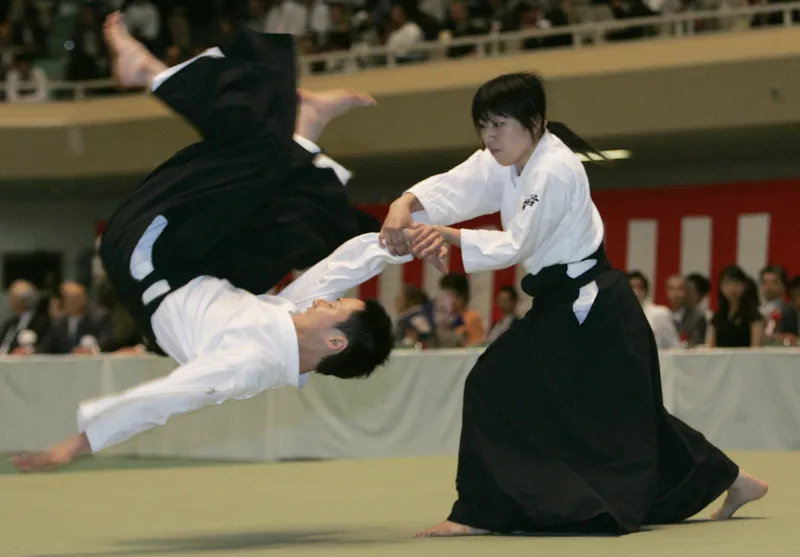
This distinction is not merely philosophical. It has practical implications for joint health, injury risk, and the sustainability of long-term practice. Movement specialists who work with older adults frequently note that aikido's emphasis on whole-body coordination, relaxed movement, and controlled falling — through the practice of ukemi — addresses several of the most clinically significant concerns associated with aging, including balance degradation and fall-related injury.
The Fall Prevention Connection
Falls represent one of the most serious public health concerns facing older Americans. The Centers for Disease Control and Prevention estimates that falls are the leading cause of injury-related death among adults 65 and older, and the physical and psychological consequences of a serious fall frequently initiate a downward spiral in overall health and independence.
Aikido's ukemi practice — the systematic training of how to fall safely — is increasingly being recognized as one of the art's most valuable offerings for older practitioners. Learning to roll, to absorb impact through distributed movement rather than rigid resistance, and to maintain spatial awareness during an unexpected loss of balance are skills with direct real-world applications that extend far beyond the dojo.
"What we are essentially teaching," said one senior instructor at a dojo in the greater Seattle area that runs a dedicated class for practitioners over 60, "is how to have a relationship with gravity that is cooperative rather than adversarial. That changes how people move through the world."
Research on tai chi — another movement art that shares some conceptual ground with aikido — has demonstrated statistically significant reductions in fall frequency among older participants. While aikido-specific longitudinal studies remain limited, practitioners and instructors report observational patterns that are consistent with these findings: older students develop noticeably improved postural awareness, gait stability, and confidence in their physical movement over the course of sustained training.
The Social Architecture of the Dojo
Beyond the physical benefits, many older practitioners identify the community dimension of dojo life as equally significant to their continued engagement with the art. The social isolation that accompanies retirement, the loss of professional identity, and the shrinking of peer networks is a well-documented challenge for Americans in their later decades. Depression and cognitive decline are both associated with reduced social engagement.
The dojo offers something that a gym, a fitness class, or a solo walking routine typically cannot: a community organized around shared learning, mutual support, and a common philosophical framework. Training partners in aikido are not competitors. They are collaborators. Every technique requires cooperation, communication, and trust — qualities that build genuine interpersonal connection over time.
Robert Castillo, 71, began training in Albuquerque after his wife encouraged him to find an activity following his retirement from federal contracting work. He had expected to feel out of place among younger students. Instead, he found that his patience, his willingness to listen, and his life experience were assets that younger training partners valued. "On the mat, my age is not a deficit," he said. "If anything, I bring something that the twenty-five-year-olds are still working toward."
Practical Modifications Without Compromise
Responsible dojos serving older populations make thoughtful accommodations without diluting the substance of the practice. These modifications are worth understanding for any older adult considering whether aikido is appropriate for their current physical condition.
Warm-up sequences can be extended and adapted to address the longer time older joints require to reach safe working temperature. Ukemi practice can be introduced gradually, beginning with seated and kneeling rolls before progressing to standing falls, and some practitioners may work primarily with slap-falls rather than full rolls depending on their shoulder and wrist health. Techniques can be practiced at reduced speed with an emphasis on structural alignment rather than dynamic execution.
None of these modifications represent a lesser form of aikido. The principles — center, extension, blending, timing — remain fully intact. What changes is the pace and the physical parameters within which those principles are explored. Many senior practitioners report that training at a more deliberate tempo actually deepens their technical understanding, because it eliminates the option of compensating for poor alignment with athletic effort.
Beginning at Any Age
One of the most encouraging aspects of aikido for older Americans is that the art genuinely does not require prior martial arts experience. Unlike sports that reward early specialization, aikido's learning curve is long and gradual, and beginners of any age are welcomed into the same training environment as advanced students. The hierarchical structure of the dojo, organized around rank and experience rather than age or athleticism, means that an older beginner is treated with the same respect accorded to any student on the path.
For Americans over 55 who are reconsidering what physical practice can look like in this chapter of their lives — who are looking for something that challenges the mind as well as the body, that builds community rather than isolation, and that can be sustained for decades rather than seasons — aikido presents a genuinely compelling answer. The mat does not ask how old you are. It asks only how present you are willing to be.