Training Together, Growing Together: Aikido as a Family Practice for American Parents and Kids

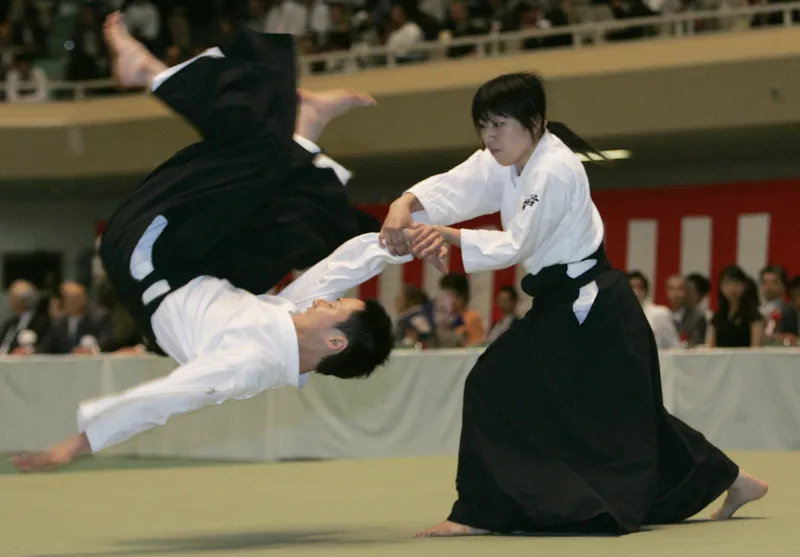
Photo: Becker1999, CC BY 2.0, via Wikimedia Commons
On a Saturday morning at a community dojo in suburban Portland, Oregon, a father and his nine-year-old daughter bow onto the mat together. He outweighs her by a hundred and thirty pounds. Within the first twenty minutes of class, she throws him — cleanly, correctly, and with visible delight. He lands well, rises, and bows to her with genuine respect. This is not a performance. This is what aikido looks like when families practice together.
Across the United States, a growing number of families are discovering that aikido offers something genuinely rare in the landscape of youth athletics: a practice where parents and children are not separated by age divisions, competitive brackets, or skill ceilings, but instead share the same floor, the same curriculum, and the same journey. The result, for many families, is a form of connection that is difficult to manufacture through conventional recreational activities.
Why Aikido Welcomes Every Age
Most contact sports are stratified by age and size for practical reasons of safety. A youth soccer league does not place adults alongside children. A wrestling program separates weight classes with precision. These separations make sense in competitive contexts, but they also mean that parents and children rarely experience the same athletic moment simultaneously.
Aikido's structure is different in a fundamental way. Because the art is predicated on redirecting force rather than generating it, size and raw strength are not the determining variables they are in most physical disciplines. Technique, timing, and body mechanics govern outcomes. A skilled smaller practitioner can and regularly does execute techniques on a larger, less experienced partner — regardless of whether that larger partner is an adult.
This equalizing quality is not incidental to aikido; it is central to its philosophy. Founder Morihei Ueshiba designed the art to function across disparate physical conditions. The practical consequence for families is that a parent and child can be genuine training partners from relatively early in a child's development, typically around age five or six depending on the dojo's youth program structure.
The Developmental Case for Children
Beyond the family bonding dimension, aikido offers a specific and well-documented set of developmental benefits for children that distinguish it from other martial arts and youth sports.
Physical coordination is the most visible benefit. Aikido's movements require the integration of balance, spatial awareness, footwork, and upper-body mechanics in ways that develop proprioception — the body's sense of its own position in space — far more comprehensively than linear sports. Children who train consistently tend to show improvements in general athletic coordination that carry over into other physical activities.
Equally significant is the emotional and social development fostered by the dojo environment. Aikido is non-competitive by design. There are no tournaments in the traditional sense, no winning or losing in the way that dominates youth sports culture in America. Instead, children learn to work cooperatively with partners, to take turns in the role of attacker and defender, and to remain responsible for a partner's safety at all times. This cooperative ethic, practiced physically and repeatedly, builds empathy in a way that verbal instruction alone rarely achieves.
Dr. Susan Kwan, a developmental psychologist who has observed youth aikido programs in the Bay Area, notes that children in consistent martial arts training that emphasizes mutual care — rather than dominance — show measurable improvements in conflict resolution behaviors outside the dojo. "They develop a physical vocabulary for de-escalation," she explains. "They've practiced it in their bodies, not just heard about it in a classroom."
Conflict Resolution Starts at Home
One of the more unexpected gifts aikido delivers to families is a shared language for navigating disagreement. Sibling conflict is one of the most persistent sources of stress in American family life. The dojo, perhaps counterintuitively, provides a structured environment in which children learn to engage conflict without the goal of domination.
When siblings train together, they are repeatedly placed in a dynamic where one must attack and one must receive — and then they switch. The roles are not fixed. Neither child is permanently the aggressor or the victim. Over time, this rotation builds a more flexible psychological relationship to conflict: the understanding that positions are temporary and that the goal is resolution, not victory.
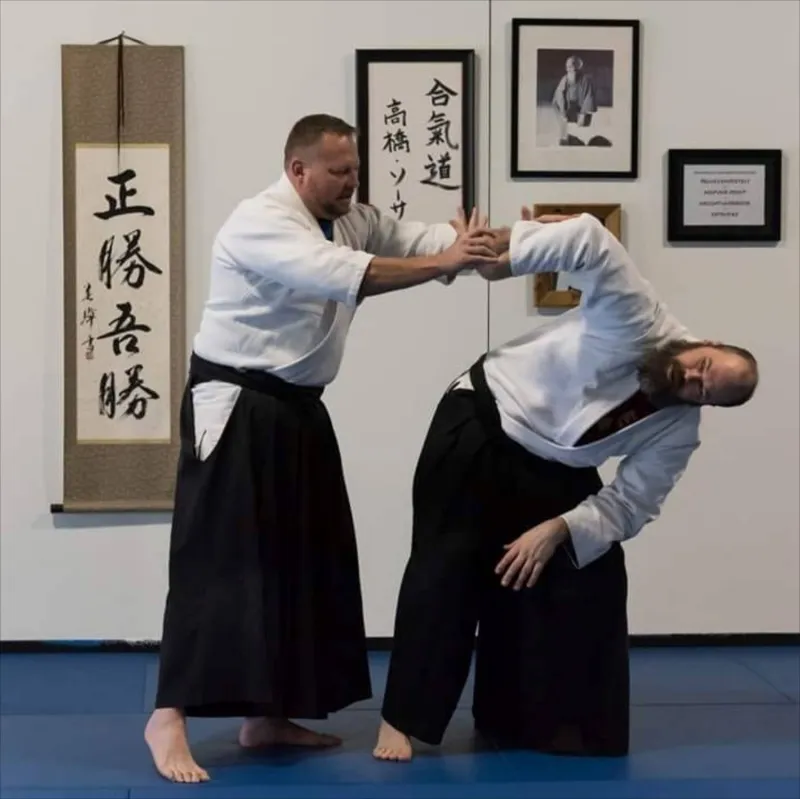
Parents who train alongside their children report an additional benefit: the mat has a leveling effect on the parent-child dynamic that can be genuinely refreshing. When a child successfully executes a wrist technique on a parent, and the parent receives it with appropriate ukemi and acknowledges the technique honestly, something shifts in the relationship. The child experiences competence in a context where the parent is genuinely present and genuinely engaged — not watching from the bleachers, but participating in the same challenge.
Finding the Right Dojo for Your Family
For parents considering aikido as a family practice, the most important initial step is visiting several dojos before committing. Not all schools are equally equipped to accommodate mixed-age family training. Here are practical considerations for American families evaluating their options:
Observe a class before enrolling. Most reputable dojos welcome visitors. Watch how the instructor interacts with younger students. Is there patience? Is there genuine instruction, or are children simply kept busy? The quality of attention given to beginners — of any age — reveals a great deal about a dojo's culture.
Ask specifically about family training policies. Some dojos offer dedicated family classes in which parents and children train together from the start. Others integrate families into general adult or youth classes at certain experience levels. Understanding the structure helps set realistic expectations.
Commit to consistency. Aikido's benefits — physical, psychological, and relational — accumulate through regular practice. Families who train two or three times per week consistently report far richer experiences than those who attend sporadically. Building the dojo visit into the weekly family rhythm, much like a shared meal, reinforces its value.
Discuss the philosophy at home. The principles children encounter in aikido — non-aggression, care for others, humility in the face of what one does not yet know — are worth naming and reinforcing in daily family conversation. When a child sees a parent genuinely wrestling with a difficult technique and persisting without frustration, the lesson is powerful. Talk about it.
A Shared Path
Aikido does not promise to eliminate family conflict, smooth every difficult conversation, or make parenting simple. What it offers is something more honest and more durable: a shared practice through which parents and children encounter genuine challenge together, develop mutual respect across the gap of age and authority, and build a physical and philosophical vocabulary for moving through difficulty with grace.
The mat is one of the few places in American family life where a parent and child can be, simultaneously, students of the same thing. That shared humility — the willingness to be beginners together — may be the most valuable thing the dojo has to offer.