Under Pressure and In Command: How Aikido Training Forges Exceptional Corporate Leaders
In a downtown Chicago conference room, a senior vice president at a logistics firm fields three simultaneous crises: a supplier chain collapse, a regulatory inquiry, and a key client threatening to walk. She does not raise her voice. She does not freeze. Instead, she centers herself with a single measured breath, assesses the forces in motion, and begins redirecting each problem toward resolution. Her colleagues call it unshakeable composure. She calls it Tuesday — and credits four years of aikido practice for it.
This is not an isolated anecdote. Across the United States, a quiet but compelling pattern is emerging among corporate leaders who train in aikido. The martial art founded by Morihei Ueshiba, built not on collision but on harmony and redirection, appears to cultivate a distinctive set of professional capabilities that conventional leadership development programs struggle to replicate.
The Neuroscience of Staying Calm When It Counts
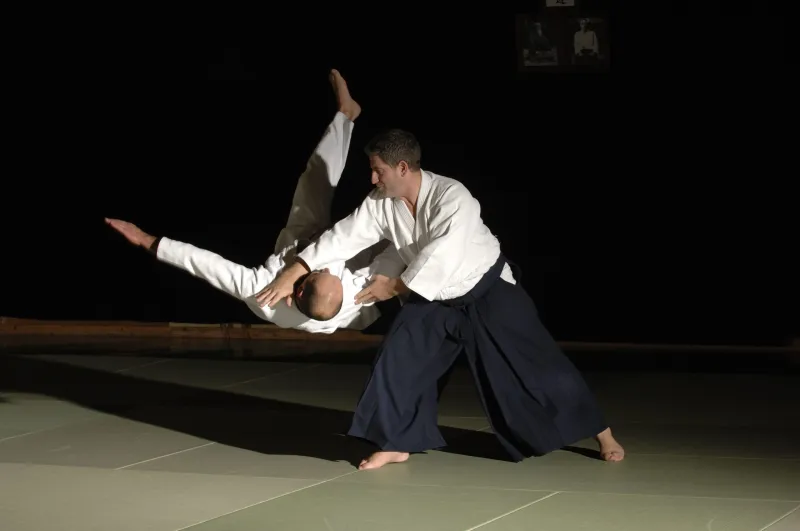
Aikido training places practitioners in repeated situations of controlled stress. A partner launches an attack; the aikidoka must receive, assess, and respond — all within fractions of a second. Over time, this repetitive exposure reshapes how the brain processes threat signals.
Research in stress neuroscience helps explain the mechanism. The prefrontal cortex, responsible for complex decision-making and impulse regulation, is precisely the region that cortisol floods suppress during acute stress. What distinguishes high-performing leaders from reactive ones is the ability to keep that prefrontal engagement online even when the amygdala is firing. Consistent martial arts training, particularly in disciplines emphasizing breath control and spatial awareness, has been associated with improved vagal tone — the physiological marker of the body's ability to self-regulate under duress.
Aikido's emphasis on musubi — the concept of blending with an incoming force rather than bracing against it — trains this response directly. The practitioner learns, physically and repeatedly, that resistance escalates conflict while redirection resolves it. That lesson does not stay on the mat.
What the Dojo Teaches That the MBA Does Not
Mark Hendricks, a former Army officer turned technology executive in Austin, Texas, began studying aikido in his mid-forties after struggling with what he described as a tendency to "meet force with force" in difficult negotiations. "I was winning arguments and losing relationships," he said. "Aikido rewired something fundamental in how I process opposition."
Within eighteen months of consistent training, Hendricks noticed a shift in his management approach. He began entering tense conversations with genuine curiosity rather than a predetermined defensive posture. He started asking what the other party's momentum was — where they were coming from and where they needed to go — before deciding how to engage. His team's voluntary turnover dropped significantly in the following year.
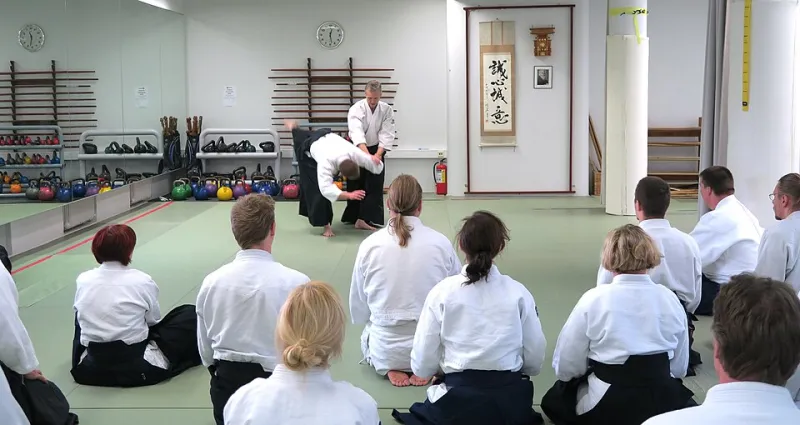
The dojo environment itself mirrors, in a concentrated form, the dynamics of a modern American workplace. There is hierarchy: the sensei, senior practitioners, and those newer to the path. There is also genuine collaboration: senior students are expected to protect junior partners during practice, not exploit their inexperience. Rank confers responsibility, not license for domination. This structure, when internalized, translates into a leadership style that commands authority without requiring intimidation.
Redirecting Rather Than Resisting: A Decision-Making Framework
One of aikido's core technical principles is entering into a situation rather than retreating from it. The irimi movement — a direct, committed step into the line of an attack — seems counterintuitive until one understands that proximity eliminates the attacker's leverage. In corporate terms, this translates to a bias for engaging problems early, before they gather momentum.
Leaders trained in this philosophy tend to move toward difficult conversations, underperforming teams, and emerging crises rather than hoping they resolve themselves. They have been conditioned, through thousands of repetitions on the mat, that hesitation is more dangerous than engaged response.
Conversely, aikido also teaches ma-ai — appropriate distance and timing. Not every moment is the right moment to act. Reading the rhythm of a situation, knowing when to let energy dissipate before engaging, is as important as the decisive entry. For executives navigating volatile markets or organizational conflict, this dual awareness — when to act and when to wait — is among the most difficult skills to develop and among the most valuable to possess.
Building Organizations That Move Like a Dojo
Several American companies have quietly incorporated aikido principles into leadership training curricula. Rather than importing the physical practice directly, these programs use the conceptual vocabulary — blending, centering, redirection, zanshin (sustained awareness) — as frameworks for organizational behavior.
Dr. Patricia Lowe, an organizational psychologist based in Seattle who consults with technology firms, has observed this trend firsthand. "What aikido offers that most leadership models don't is an embodied practice," she notes. "You cannot intellectualize your way through a randori session. You have to develop genuine physical and psychological integration. That integration carries over."
The implications extend to team dynamics. Aikido practitioners who move into management roles frequently describe a heightened sensitivity to group energy — the ability to sense when a team is carrying unresolved tension, when momentum is building in a productive direction, or when a project is about to tip into chaos. This perceptual acuity, sharpened through years of reading a partner's intent before it becomes explicit action, constitutes a form of emotional intelligence with a distinctly kinesthetic foundation.
The Path Forward
For professionals considering aikido as a complement to their leadership development, the entry point is straightforward: find a reputable dojo, commit to consistent practice, and resist the temptation to treat training as purely physical exercise. The philosophical dimensions of the art — its insistence on non-aggression, its cultivation of presence, its demand that the practitioner remain responsible for their partner's safety even while executing a technique — are inseparable from its practical benefits.
The American corporate landscape rewards those who can perform under pressure without sacrificing judgment or relationships. Aikido, practiced with sincerity, develops precisely those capacities. The paradox at the heart of this martial art — that mastery of conflict resolution requires the abandonment of the fighting mindset — turns out to be an extraordinarily useful professional philosophy.
The dojo does not promise an easier career. It promises a practitioner better equipped to walk the difficult path with clarity, steadiness, and genuine regard for those around them. In any organization, that is a rare and valuable presence.