Starting Strong: Five Technical and Mental Errors New Aikido Students Make in Their First Year
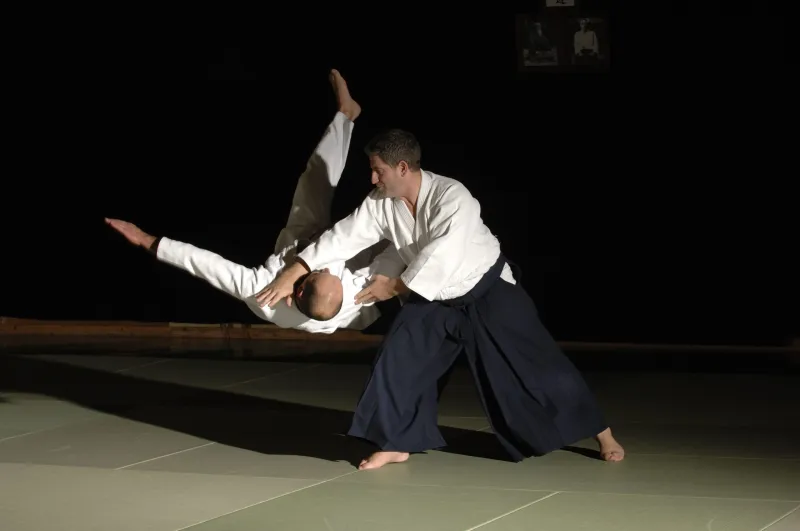
Photo: aikido beginner student practicing rolls on mat in dojo, via aikido-yoshinkan-france.fr
Every aikido practitioner remembers the early confusion—the unfamiliar vocabulary, the seemingly effortless techniques demonstrated by senior students that somehow collapse entirely when attempted independently, the persistent feeling that everyone else in the dojo has access to information you have not yet received. The first year is, by any honest measure, humbling. It is also foundational. The habits, attitudes, and physical patterns established in those early months tend to persist long after the student has forgotten forming them.
For instructors and students alike, recognizing the most common errors of the beginner phase is genuinely valuable. These mistakes are not signs of inadequacy—they are predictable features of the learning curve, shared by the vast majority of new practitioners regardless of prior athletic background. What follows is a practical breakdown of five recurring errors, why they happen, how they impede progress, and what can be done to address them.
Mistake 1: Treating Ukemi as an Afterthought
Ukemi—the art of receiving technique, encompassing rolls, breakfalls, and controlled falls—is introduced to beginners almost immediately, yet it is frequently undervalued by new students who are impatient to learn throws and joint locks. This is understandable. Falling does not feel like martial arts. It feels like falling.
The consequence of neglecting ukemi development is significant. Poor ukemi limits the intensity at which a training partner can safely apply technique, which in turn limits what the practicing student actually feels and learns. Aikido is largely transmitted through physical sensation—the sensation of being off-balance, redirected, and guided through space. A student who cannot receive technique safely will never fully experience what good technique actually feels like, which makes replicating it nearly impossible.
The correction: Treat ukemi practice as its own discipline, not a prerequisite to the "real" training. Arrive early to practice rolls independently. Ask senior students to observe your breakfalls. Many experienced practitioners will note that their ukemi improved most dramatically when they began paying it the same deliberate attention they gave to their throws.
Mistake 2: Muscling Through Techniques
New students, particularly those with backgrounds in strength sports, wrestling, or other physically demanding disciplines, frequently attempt to compensate for underdeveloped technique by applying muscular force. The arm bar that isn't working quite right gets cranked harder. The throw that isn't flowing gets pushed through. This approach produces results of a kind—a compliant training partner may go along with it—but it builds precisely the wrong neural pathways.
Aikido technique is predicated on leverage, timing, and structural alignment. When force substitutes for these elements, the student never develops the sensitivity required to apply the technique against genuine resistance or against a larger, stronger opponent. Worse, the habit of muscling can mask technical errors for months, allowing them to calcify before anyone notices.
The correction: When a technique isn't working, the instinct should be to use less force, not more. Ask yourself where the leverage point is, whether your posture is aligned, and whether you are moving from your center or from your arms. If the technique still fails, that failure is information. Seek feedback from your instructor rather than powering through.
Mistake 3: Neglecting Posture and Center
Ironically, one of aikido's most fundamental concepts—moving from and protecting one's center of gravity, or hara—is one of the first things beginners abandon under pressure. When a technique becomes challenging, students characteristically hunch forward, lock their knees, raise their shoulders, or crane their necks. Any of these postural collapses undermines both stability and the efficient transfer of body mechanics into technique.
The problem is partly attentional. Beginners are processing an enormous volume of new information simultaneously—hand placement, foot position, the movement of their partner—and posture falls off the cognitive priority list. Over time, if not corrected, poor postural habits become invisible to the student because they no longer register as unusual.
The correction: Instructors often recommend periodic posture checks as a training ritual rather than a correction applied only when something goes wrong. Before beginning a technique, pause briefly to establish upright alignment, relaxed shoulders, and slightly bent knees. Many dojos in the United States incorporate explicit posture awareness into warm-up exercises for exactly this reason. Video review, where available, can also be revelatory—most students are genuinely surprised by what their posture looks like from the outside.
Mistake 4: Misunderstanding the Role of Timing
Timing in aikido is subtle and deeply counterintuitive. Effective technique generally requires meeting the attack at a specific moment—not too early, not too late—and blending with its momentum rather than waiting for it to fully arrive or reacting after it has passed. Beginners almost universally struggle with this, defaulting to one of two errors: moving prematurely before the attack has committed, or hesitating until the moment has passed.
Both errors stem from the same root cause: anxiety. The beginner is thinking about the technique rather than feeling the interaction. They are rehearsing steps in sequence rather than responding to what is actually happening. This cognitive load disrupts the sensory attunement that good timing requires.
The correction: The most effective remedy for timing problems is repetition with a patient, cooperative partner at reduced speed. Slowing the interaction down allows the student to begin feeling the moment of commitment rather than calculating it. As sensitivity develops, speed can be incrementally restored. Rushing this process—moving to full speed before the timing instinct has formed—tends to reinforce rather than correct the underlying problem.
Mistake 5: Measuring Progress Against Unrealistic Timelines
Perhaps the most damaging mistake of the first year is not technical at all. It is the expectation that proficiency should arrive quickly—a belief shaped by the compressed timelines of fitness culture, online tutorials, and the general American tendency to measure achievement in visible, near-term outcomes.
Aikido does not cooperate with this expectation. The art is genuinely complex, its subtleties revealing themselves across years and decades rather than weeks and months. Students who enter the dojo expecting to feel competent within a few months are almost certain to feel frustrated, and frustration that is not understood as a natural feature of the learning process frequently leads to attrition.
The correction: Reframe the measurement of progress. Instead of asking whether you can perform a technique reliably, ask whether your ukemi is smoother than it was last month, whether you are more relaxed during practice than you were at the beginning, whether you understand more of what your instructor is demonstrating even if you cannot yet replicate it. These incremental shifts are the actual substance of early-stage development. Recognizing them requires a different kind of attention—and cultivating that attention is itself one of the most important things the first year can teach.
A Foundation Worth Building Carefully
The first year of aikido is not meant to produce mastery. It is meant to produce a foundation—physical, mental, and relational—upon which everything that follows will be built. The students who emerge from that year with clean habits, honest self-assessment, and genuine curiosity about the art tend to become the senior practitioners others look to years later. The errors described here are not obstacles to that outcome. Recognized and addressed, they are part of the path itself.