Less Talk, More Feel: Why Aikido's Culture of Silent Correction Produces Faster, Deeper Learners
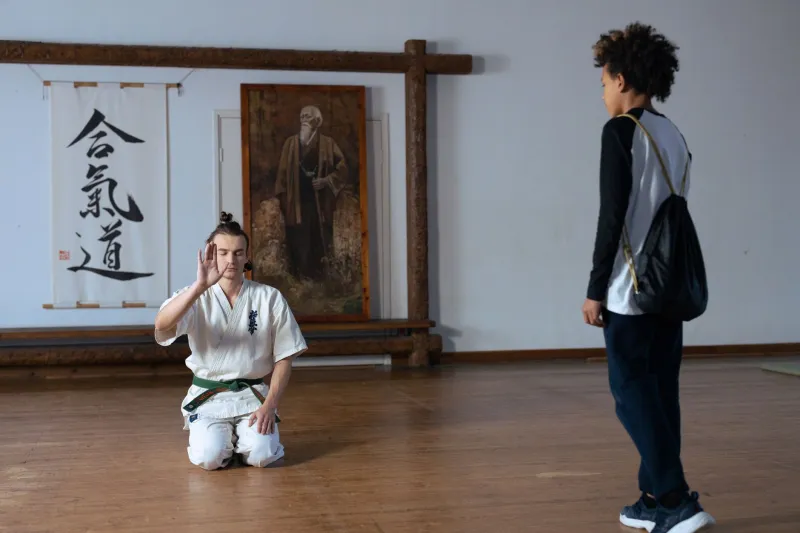
Walk into a well-run aikido dojo during a regular class, and you may be struck by something unexpected: the relative quiet. The instructor demonstrates a technique. Students pair up and begin working. Corrections, when they come, often arrive not as spoken commentary but as a gentle repositioning of the wrist, a subtle shift applied to the student's shoulder, a brief moment of physical dialogue that communicates more than a paragraph of verbal instruction could.
This is not accidental. It reflects a deeply considered pedagogical tradition—one that modern learning science is only beginning to catch up with.
The Information Overload Problem in Contemporary Coaching
American athletic culture has become, in many respects, a coaching culture. From youth soccer to corporate leadership development, the dominant model involves continuous verbal feedback: what you did wrong, what you should do instead, what to focus on next time. The assumption underlying this model is that more information produces better outcomes.
The evidence, however, is considerably more complicated.
Researchers studying motor learning have documented a phenomenon known as the guidance hypothesis—the finding that frequent, detailed feedback during skill acquisition can actually impair long-term retention and transfer. When learners receive constant correction, they become dependent on that external input rather than developing the internal sensory reference points needed for independent performance.
Additionally, cognitive load theory, developed by educational psychologist John Sweller, establishes that working memory is sharply limited. When a student is attempting to integrate a new physical movement while simultaneously processing verbal instruction, the cognitive demands compete with each other. The body and the mind pull in different directions, and neither learns as efficiently as it might with appropriate space.
What Proprioceptive Learning Actually Means
Aikido's corrective tradition leans heavily on what researchers call proprioceptive learning—the acquisition of skill through the body's internal sensing systems rather than through external description. Proprioception, sometimes called the "sixth sense," refers to the nervous system's continuous monitoring of joint position, muscle tension, and movement in space.
When an experienced aikido instructor physically guides a student's arm through the correct arc of a kotegaeshi or adjusts the angle of a tenkan step, the instructor is not merely demonstrating—they are writing information directly into the student's nervous system. The student feels what correct technique actually is, not what it sounds like when described.
This distinction matters enormously. Language is an abstraction. Movement is immediate and concrete. The body learns movement by experiencing it, and the most direct route to that experience is physical contact from someone who already possesses it.
The Neuroscience of Embodied Transmission
Neuroscience provides additional support for this model. Mirror neuron research, while still subject to ongoing debate about its precise scope, suggests that the brain simulates observed and felt actions using overlapping neural networks. When a student watches a senior practitioner execute a technique and then receives hands-on adjustment, multiple learning pathways are activated simultaneously—visual, proprioceptive, and kinesthetic.
Researcher Scott Grafton at the University of California, Santa Barbara, has studied how motor expertise is encoded in the brain, finding that skilled movement becomes increasingly automatic and subcortical over time—operating below the threshold of conscious verbal thought. This is precisely the neural architecture that aikido training seeks to build: technique that operates faster than language, responding to physical reality before the analytical mind has time to intervene.
Verbal instruction, by its nature, routes through analytical processing. Touch bypasses it.
Why Silence Creates Attention
There is also a psychological dimension to the aikido learning environment that is easy to overlook. When students know that corrections will not come as a stream of verbal commentary, they develop a different quality of attention. They learn to read their partner's reactions, to notice when a technique is generating resistance versus flowing freely, to calibrate based on felt feedback rather than waiting for external evaluation.
This is active learning in its most demanding form. The student must develop internal standards, not merely compliance with external ones.
Dana K., who has trained for nine years at a dojo in the Chicago area and holds a second-degree black belt, describes the shift this way: "In my first year, the silence was frustrating. I wanted someone to tell me exactly what I was doing wrong. By my third year, I realized I was learning to feel the difference myself. That's when training really accelerated. No one could have told me what I now know—I had to feel it."
Implications Beyond the Mat
The implications of this model extend meaningfully into other domains where skill development matters.
In corporate training contexts, research by the Harvard Business School's Robin Ely and others has found that constant performance feedback can undermine the psychological safety needed for genuine learning—creating environments where employees perform for the feedback rather than developing authentic competence. The aikido alternative suggests that creating structured space for independent practice and felt experience may produce more durable capability than continuous managerial commentary.
In youth development and parenting, the same principle surfaces. Developmental psychologists have long noted that children allowed to problem-solve through struggle—without immediate verbal rescue—develop stronger executive function and greater intrinsic motivation than those who receive continuous adult guidance. The dojo, in this light, models something that American parenting culture often resists: productive silence.
The Art of the Well-Timed Word
It would be misleading to suggest that aikido training involves no verbal instruction whatsoever. Senior instructors speak. Principles are explained. History and philosophy are transmitted through language. The distinction lies in proportion and timing.
Verbal instruction in the aikido tradition tends to be sparse, precisely chosen, and offered when the student's body is ready to receive it—often after repeated physical practice has created a context of felt experience within which the words can land meaningfully. This sequencing reverses the conventional model, which typically explains before practicing.
The research on interleaved and spaced practice suggests that this sequencing may be more than tradition. When explanation follows experience, it connects to something the learner's nervous system has already begun to encode, making the verbal content far more memorable and actionable.
Rediscovering What the Body Already Knows
Aikido's approach to learning is, in some respects, a recovery of something older than modern coaching culture—a recognition that the human body is an extraordinarily sophisticated learning instrument, capable of acquiring complex skills through direct experience in ways that verbal description cannot fully replicate or replace.
For practitioners and instructors alike, this tradition is an invitation to trust the mat, trust the practice, and trust the quiet. The body, given appropriate conditions, knows how to learn.