Flow Over Force: How Aikido's Non-Resistance Principle Quietly Dismantles Destructive Habits
There is a familiar script for breaking a bad habit in America. You decide you are done. You white-knuckle through the first few days. You rely on sheer determination, and for a while it works—until it doesn't. The relapse feels like personal failure, proof that you simply lacked the discipline to succeed.
Aikido, a martial art built on the premise that direct opposition is rarely the most efficient response, offers a different script entirely.
The Problem With Fighting Yourself
Modern behavioral science has begun to confirm what aikido practitioners have understood through physical practice for decades: resistance amplifies force. When you tell yourself not to think about something, you think about it more. When you label a craving as the enemy and attempt to overpower it, the neurological systems governing that craving often intensify in response.
Psychologist Daniel Wegner's landmark research on ironic process theory demonstrated that deliberate attempts to suppress a thought reliably increase its frequency. The brain, it turns out, monitors for the very thing you are trying to avoid—keeping it perpetually active. Willpower, far from being a limitless resource, is a finite cognitive fuel that depletes with use, a phenomenon psychologist Roy Baumeister termed ego depletion.
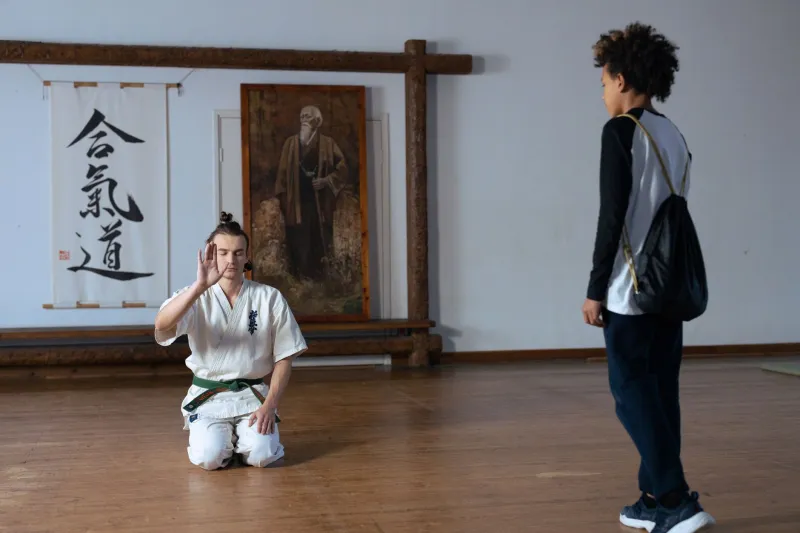
Aikido's foundational principle—aiki, or the harmonizing of energy—addresses this exact problem, not as a philosophical abstraction but as a practical technique with direct neurological parallels.
Redirection, Not Suppression
On the mat, when a trained aikidoka encounters an incoming force, the response is never a static block. Instead, the practitioner moves to receive the energy, aligns with its direction, and then subtly redirects it toward a resolution that neutralizes the threat. The attacker's momentum becomes the mechanism of their own undoing.
Applied to habit formation, this looks less like white-knuckling and more like what acceptance and commitment therapy (ACT) practitioners call defusion—the process of acknowledging an urge without immediately acting on it or violently suppressing it. Rather than treating a craving as an adversary, the practitioner observes it, allows it to crest, and redirects attention toward a chosen behavior.
Marcos R., a black belt instructor who teaches at a dojo in the Denver metro area, describes the translation this way: "In the early years, I tried to quit smoking through willpower. I failed repeatedly. After several years of aikido training, I tried something different. Instead of fighting the craving, I just watched it—the same way I watch an incoming strike. I let it come in, noted where it was going, and then I moved. I haven't smoked in eleven years."
This is not coincidence. It reflects a genuine shift in how the nervous system processes threat.
What Neuroscience Says About 'Going With It'
Research on mindfulness-based interventions for addiction—particularly Judson Brewer's work at Brown University's Mindfulness Center—has produced compelling data. Brewer's studies on smoking cessation found that mindfulness-based approaches outperformed standard cessation programs by a factor of roughly five to one, not by suppressing cravings but by cultivating what he calls curiosity about the craving itself.
The mechanism is significant. When a practitioner engages curiously with a craving rather than recoiling from it, activity in the posterior cingulate cortex—a region associated with self-referential rumination and craving reinforcement—decreases measurably. The craving loses its grip not because it was overpowered but because the practitioner stopped feeding it with reactive resistance.
Aikido training cultivates precisely this capacity. Hours spent on the mat learning to receive force without flinching, to remain centered under pressure, and to redirect rather than oppose builds a neurological flexibility that extends well beyond physical technique.
Procrastination and the Energy of Avoidance
The same logic applies to procrastination, one of the most stubborn forms of self-sabotage in contemporary American professional life. Procrastination is rarely about laziness. Research by psychologist Fuschia Sirois and others frames it primarily as an emotion-regulation problem—specifically, the avoidance of the negative feelings associated with a task.
The harder you fight the avoidance, the more emotionally charged the avoided task becomes. The aikido-informed response is to reduce the charge by entering the discomfort rather than circling it. Beginning a task for two minutes—not to finish it, but simply to make contact with it—mirrors the aikido principle of irimi, or entering. You move toward the incoming energy instead of retreating from it.
Practitioners who have absorbed this principle through years of physical training often report that it begins to operate automatically in other domains. The mat is, in this sense, a laboratory for rewiring habitual responses to discomfort.
Flow States and the Dissolution of Resistance
There is one more layer worth examining. Aikido training, when practiced with appropriate relaxation and attentiveness, reliably produces states that psychologist Mihaly Csikszentmihalyi identified as flow—the experience of complete absorption in an activity, characterized by effortlessness, clarity, and the temporary dissolution of self-consciousness.
Flow states are neurologically incompatible with the anxious self-monitoring that sustains bad habits. You cannot be simultaneously absorbed in a graceful koshinage and ruminating about your urge to scroll social media for the fourth hour. The practice creates windows of genuine freedom from habitual patterns, and those windows, repeated consistently, gradually widen.
A Different Kind of Discipline
This is not an argument against discipline. Aikido demands extraordinary commitment, consistency, and honest self-assessment. But it reframes the object of discipline. Rather than disciplining yourself to fight your own impulses, you discipline yourself to receive them skillfully—to observe without reacting, redirect without suppressing, and move through discomfort without being captured by it.
For Americans navigating a culture saturated with self-improvement rhetoric that often reduces to "try harder," this reframe carries real practical value. The path through self-sabotage may not be more force. It may be better technique.
As O Sensei Morihei Ueshiba, the founder of aikido, reportedly observed: "The secret of aikido is to harmonize ourselves with the movement of the universe and bring ourselves into accord with the universe itself." That begins, for most of us, with learning to harmonize with the movements happening inside ourselves—including the ones we have been trying, unsuccessfully, to stop.