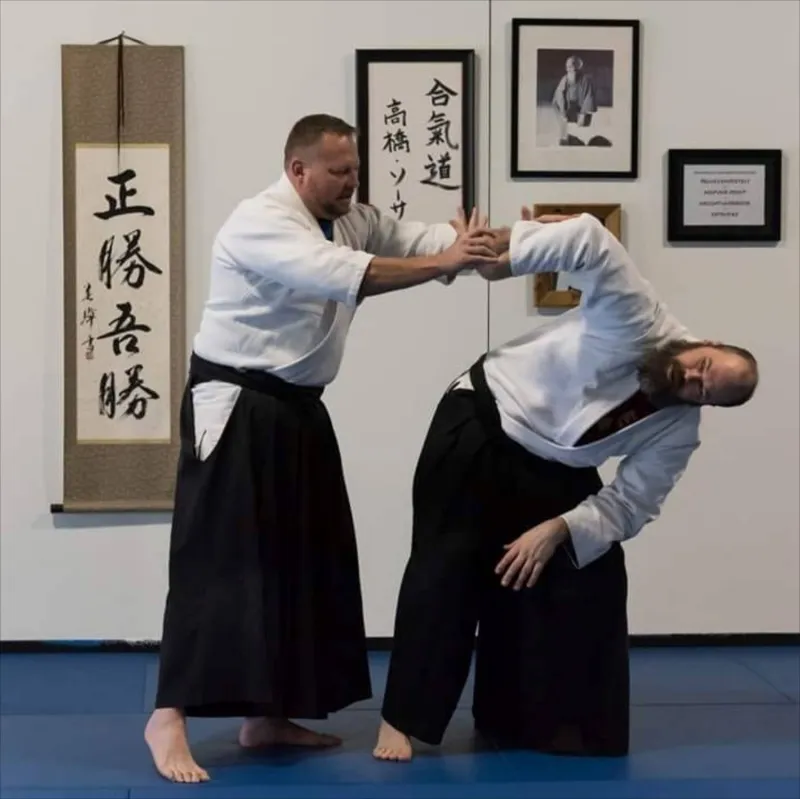
Size Is Just a Number: How Aikido's Principles Empower Smaller Practitioners Against Larger Opponents
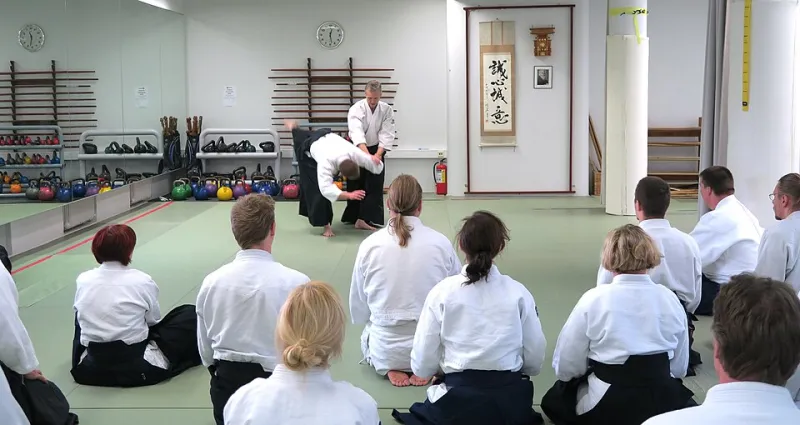
Photo: Opkangas, CC BY-SA 4.0, via Wikimedia Commons
Walk into virtually any aikido dojo across the United States, and you are likely to witness something that defies common athletic intuition: a practitioner of modest stature redirecting a significantly larger partner's attack with apparent ease. No brute effort. No visible strain. Just timing, geometry, and an intimate understanding of how the human body moves through space. For newcomers, this can appear almost theatrical. For those who study the underlying mechanics, it is entirely logical.
Aikido was designed from its inception to function independently of physical superiority. Its founder, Morihei Ueshiba, explicitly articulated this intent—he envisioned a martial art accessible to practitioners regardless of age, gender, or body size. Decades of dojo practice across the country have borne this out in tangible, repeatable ways.
The Geometry of Force: Why Leverage Trumps Mass
The most immediate reason smaller aikidoka can neutralize larger opponents is rooted in classical mechanics. Leverage—the relationship between force, distance, and a fulcrum point—fundamentally alters the equation of physical confrontation. When an aikidoka applies a joint lock such as nikyo or sankyo, the technique exploits the natural mechanical disadvantage of the wrist, elbow, or shoulder joint. The pain compliance and structural compromise these locks generate are not proportional to the practitioner's body weight; they are proportional to the precision of the angle applied.
Consider the physics: a smaller practitioner applying a correctly angled wrist lock does not need to overpower a larger opponent's arm muscles. Instead, the technique directs force into the joint in a direction those muscles are anatomically ill-equipped to resist. The larger the opponent's mass, in some cases, the more momentum is available to be redirected against them.
Sensei Dana Hurst, who has taught aikido at a community dojo in the Pacific Northwest for over two decades, describes it plainly: "When students first arrive, they think this is about strength matching strength. The first thing we do is disabuse them of that notion. We work with the body's architecture, not against it. A bigger person simply has more architecture to work with."
Blending and Redirection: Turning Energy Into an Ally
Beyond leverage, aikido's concept of aiki—the harmonious merging with an opponent's energy—provides a second, equally powerful mechanism. Rather than meeting force with opposing force, a trained aikidoka learns to move in concert with an incoming attack, borrowing its momentum and guiding it to an unbalancing conclusion.
This principle is sometimes called "blending," and it is perhaps the most counterintuitive skill in the art. A smaller practitioner who attempts to stop a larger opponent's forward charge directly will almost certainly fail. The same practitioner who steps off the line of attack, merges with the incoming energy, and redirects it through a technique like irimi-nage or tenchi-nage can send that larger opponent off-balance with comparatively minimal effort.
The biomechanical explanation involves the center of gravity. When a larger person commits to an attack, their center of mass moves forward. A skilled aikidoka does not contest this movement—they accelerate it past a stable base, effectively using the attacker's own momentum to accomplish the unbalancing. The larger the attacker, the more momentum is available to be redirected.
Dr. Karen Yoshida, a sports kinesiologist who also holds a third-degree black belt in aikido, has studied this phenomenon closely. "What we observe in advanced practitioners is an extraordinary sensitivity to weight shifts and postural cues," she notes. "They learn to read an opponent's center before the technique even begins. That skill is entirely trainable, and it has nothing to do with how much you weigh."
The Role of Posture and Structural Alignment
Smaller practitioners often develop a distinct advantage in one area that is rarely discussed: the cultivation of shizentai, or natural upright posture, combined with a low, stable center of gravity. Because they cannot rely on mass to stabilize themselves during techniques, smaller aikidoka frequently develop superior body mechanics out of necessity.
This necessity-driven refinement often produces cleaner, more efficient technique over time. A larger practitioner who can "muscle through" a poorly executed throw may never be forced to correct underlying errors in footwork or hip rotation. A smaller practitioner who attempts the same shortcut simply fails—and that immediate feedback accelerates technical development.
Instructors at several dojos in the Chicago area report a consistent pattern: their most technically precise advanced students often come from the lighter weight categories. The art, in a sense, rewards those who have no alternative but to pursue precision.
Mindset as a Force Multiplier
The physical principles alone do not fully account for the phenomenon. Mindset plays a measurable role. Smaller practitioners who have internalized aikido's philosophy tend to approach encounters with a quality of calm focus that itself influences outcomes. The psychological dimension of conflict—the hesitation, the intimidation, the reactive tension—affects physical performance directly.
Aikido training cultivates what instructors often call zanshin, a state of relaxed, extended awareness. A practitioner operating from this state remains sensitive to subtle cues, responds without telegraphing, and executes technique with a fluidity that tense muscles cannot produce. Paradoxically, this mental composure is often more accessible to smaller practitioners who have accepted that raw power is not their primary tool.
At a dojo in Austin, Texas, head instructor Miguel Reyes puts it this way: "The students who struggle most are often the bigger, stronger ones who come in thinking they already know how to handle themselves. They have to unlearn a lot. The smaller students? They arrive humble. They listen. And over time, that humility becomes their greatest technical asset."
Practical Implications for Training
Understanding these dynamics has direct implications for how training should be structured. Dojos that pair smaller practitioners exclusively with same-size partners inadvertently limit their development. Exposure to a range of body types—particularly larger, heavier ukes—is essential for testing whether technique is genuinely clean or merely adequate.
For smaller practitioners specifically, focusing on the following areas accelerates the development of size-independent effectiveness:
- Timing over strength: Initiating technique at the precise moment of an opponent's committed movement, not before or after.
- Entry angles: Mastering the geometry of off-line movement to avoid direct force confrontation.
- Joint mechanics: Developing sensitivity to the precise angles that compromise structural integrity without relying on grip strength.
- Center-to-center connection: Learning to connect one's own center of gravity to the opponent's, enabling whole-body redirection rather than arm-only manipulation.
The Larger Truth
The phenomenon of smaller aikidoka outperforming larger opponents is not a curiosity or an exception. It is, in fact, the clearest demonstration that the art's foundational principles are functioning as intended. Aikido does not promise that size is irrelevant in every conceivable confrontation. What it does offer is a systematic method for reducing the relevance of size through the disciplined application of leverage, timing, and energy harmony.
For practitioners across the United States who may feel physically outmatched on the mat, this is not a reason for discouragement. It is an invitation. The path to effectiveness runs directly through the principles themselves—and those principles are available to anyone willing to study them with sufficient patience and rigor.