Setback to Comeback: How Aikido's Principles Create a Faster, Smarter Path Through Injury and Burnout

Every martial artist, regardless of discipline, will eventually confront the unwelcome reality of a setback. Whether it arrives as a torn ligament, a strained shoulder, or the slow erosion of motivation that practitioners call burnout, the question is never simply if it will happen — it is how you will navigate it when it does. What distinguishes aikido in this conversation is not that its practitioners are immune to injury or fatigue. Rather, it is that the very principles embedded in the art appear to accelerate recovery and build a more durable relationship with training over the long term.
For practitioners across the United States — from weekend students at community dojos to dedicated black belts with decades of experience — this recovery advantage is something many describe only in hindsight, once they have compared their experience to peers in higher-impact disciplines. Understanding why it exists requires a closer look at both the biomechanics of aikido movement and the psychological architecture the practice quietly constructs.
The Biomechanical Foundation: Moving Without Destroying
At its structural core, aikido is an art built around circular motion, relaxed musculature, and the redirection of force rather than its direct absorption. These are not merely aesthetic choices — they carry significant physiological consequences.
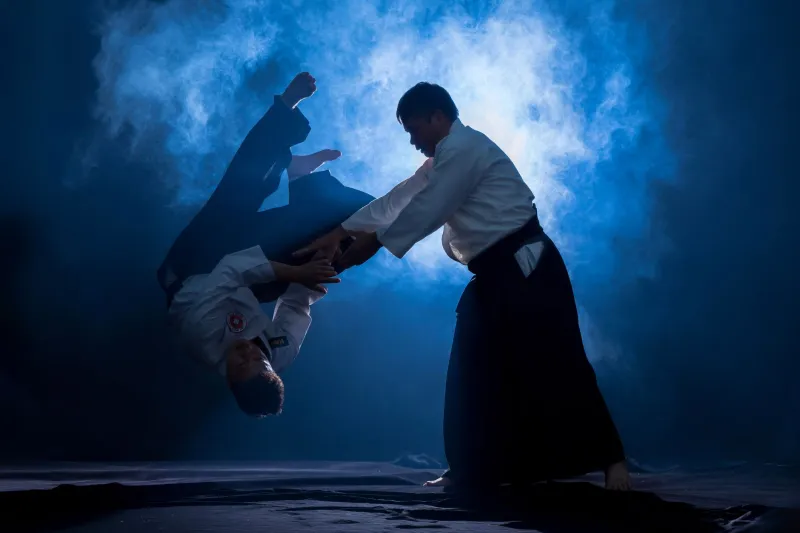
High-impact martial arts, contact sports, and even certain fitness disciplines place repetitive compressive and shear forces on joints, particularly the knees, hips, and lumbar spine. Over time, this cumulative load contributes to the kind of wear that sidelines athletes for weeks or months. Aikido's design fundamentally reduces this equation. Techniques are executed through whole-body rotation and weight transfer rather than through isolated muscular force. Falling — one of the most injury-prone moments in any physical discipline — is transformed through ukemi practice into a controlled, low-impact skill that distributes force across large surface areas and trains the nervous system to respond fluidly rather than rigidly.
This matters enormously during recovery. When a practitioner returns to the mat following an injury, they are not re-entering an environment that will immediately re-stress the same compromised tissue. With appropriate modification, many aspects of aikido training can be resumed earlier than would be advisable in a striking or grappling art, simply because the foundational movements are less mechanically aggressive.
Physical therapists working with athletic populations have increasingly recognized that maintaining low-load movement during recovery — rather than complete rest — supports tissue remodeling and preserves neuromuscular coordination. Aikido's movement vocabulary, when practiced mindfully, aligns well with this evidence-based approach.
What Experienced Practitioners Describe
Talk to aikidoka who have trained for ten years or more, and a pattern emerges in how they describe their experiences with injury. Many report that returning to the dojo, even in a limited capacity, accelerated rather than delayed their recovery.
One practitioner in the Pacific Northwest, a nidan who sustained a rotator cuff injury several years ago, described continuing to attend class and work on footwork, breathing exercises, and observational learning while her shoulder healed. She credits that sustained connection to the practice — the community, the rhythm of the dojo, the continued engagement with technique at a conceptual level — with shortening both her physical and psychological recovery timeline.
A long-time student in the Midwest echoed a similar experience following a knee surgery that would have ended participation in his previous sport entirely. Because aikido offered him ways to remain meaningfully engaged with training while gradually reintroducing load-bearing movement, he never experienced the complete disconnection from practice that so often deepens burnout and delays return.
These accounts are not outliers. They reflect a structural truth about how aikido's learning environment is organized.
The Psychology of Non-Resistance in Recovery
Burnout — the psychological counterpart to physical injury — is arguably more common and less openly discussed in martial arts communities. It typically arises from a collision between expectation and reality: training feels stale, progress seems invisible, or the demands of the dojo begin to feel like obligations rather than invitations.
Aikido's philosophical framework offers an unusually practical set of tools for navigating this state. The principle of non-resistance, which practitioners spend years internalizing on the mat, translates directly into how a skilled aikidoka approaches adversity off of it. Rather than forcing through resistance — whether that resistance is a physical injury or an exhausted mind — the trained response is to acknowledge the force, move with it, and redirect energy toward what is available rather than fixating on what is not.
This is not passive resignation. It is an active, intelligent reorientation. A practitioner experiencing burnout who applies this principle might step back from formal randori and spend several weeks focused exclusively on the meditative dimensions of the practice: breathing, posture, the quality of attention. The art provides enough depth that this kind of lateral exploration is genuinely possible — there is always another layer to investigate.
Research in sports psychology consistently identifies perceived autonomy and a sense of continued progress as critical buffers against burnout. Aikido's breadth of study — technical, philosophical, relational — gives practitioners multiple domains in which to experience both.
Practical Strategies for Injury Prevention and Resilient Training
Understanding the recovery advantage is one thing. Building training habits that prevent unnecessary setbacks in the first place is another. Several evidence-supported practices align naturally with aikido's principles and deserve explicit attention.
Prioritize ukemi as a lifelong skill. Many injuries in aikido occur not during technique execution but during falls, particularly among students who have not yet developed confident, reflexive ukemi. Investing consistent attention in falling practice — regardless of rank — pays dividends that compound over a career.
Train the edges of your range of motion, not beyond them. Aikido wrist and joint techniques can place significant stress on connective tissue when applied without proper alignment. Instructors and partners bear a shared responsibility for calibrating intensity appropriately, particularly with newer practitioners.
Treat rest as training. American culture often pathologizes rest as laziness, but recovery is when adaptation occurs. Scheduling deliberate rest periods — and viewing them as part of the training cycle rather than interruptions to it — is consistent with both sports science and aikido's broader philosophy of sustainable effort.
Maintain communication within your dojo. The community dimension of aikido practice is a genuine recovery resource. Instructors who know about a student's physical limitations can modify training accordingly. Partners who understand your current condition can adjust their energy and technique. This kind of transparent collaboration is one of the reasons dojo culture, at its best, functions as a genuine support system.
A Practice Built for the Long Arc
Aikido was never designed to produce peak performance over a short competitive window. It was conceived as a practice for life — something that deepens and evolves alongside the practitioner across decades. That orientation shapes everything, including how the art responds to the inevitable disruptions that every human body and mind will encounter.
The recovery paradox, then, is not really a paradox at all. It is the natural consequence of training in a system that treats efficiency, adaptability, and long-term sustainability as foundational values rather than secondary concerns. When setbacks arrive — and they will — the practitioner who has genuinely internalized these values does not simply recover from the interruption. They often return to the mat with a clearer understanding of their own practice than they possessed before.
That, perhaps, is the most honest measure of the art's depth.