Confidence Without the Bulk: The Hidden Psychology Behind Aikido's Quiet Power
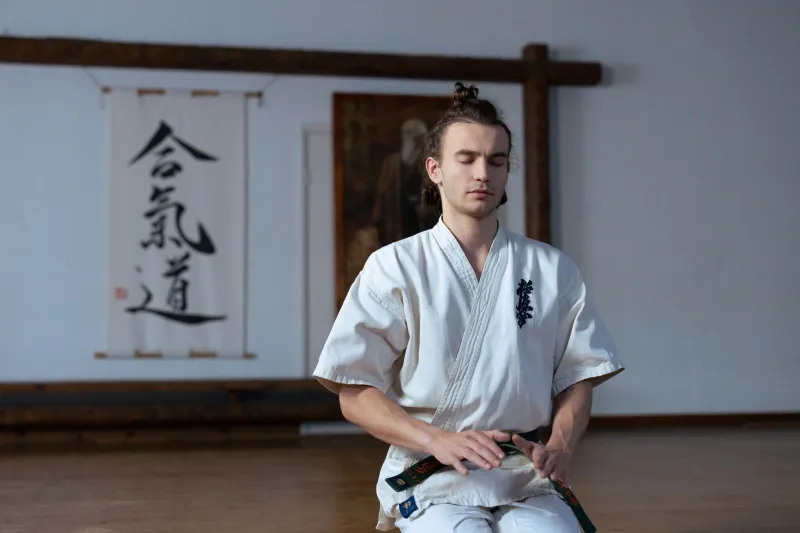
Walk into any boxing gym or karate dojo in America and you will find a familiar visual vocabulary of confidence: defined musculature, explosive movement drills, the unmistakable physicality of athletes who have built their bodies into instruments of force. Then walk into an aikido dojo. The picture is different. Practitioners range from slender to stocky, from twenty-two to seventy. Yet speak with them for even a few minutes and something unmistakable emerges—a quality of settled, unshakable presence that is difficult to articulate but impossible to miss.
This raises a genuinely interesting question for anyone who studies the relationship between physical training and psychological state: how does a martial art that does not prioritize muscle building, maximum strength output, or explosive power development produce practitioners who report such profound levels of self-assurance? The answer, as both neuroscience and long-term practitioners suggest, is that aikido is constructing confidence through an entirely different mechanism—one that may, in certain respects, be more durable than the kind forged in the weight room.
The Body's Internal Map: Proprioception as Foundation
At the neurological level, much of what distinguishes aikido training from strength-focused disciplines comes down to proprioception—the body's continuous, largely unconscious process of mapping its own position, weight distribution, and movement through space. Most physical training improves proprioception incidentally. Aikido develops it deliberately and relentlessly.
Every technique in the art requires a practitioner to simultaneously sense their own center of gravity, read their partner's balance point, and execute precise redirections that depend on millimeter-level accuracy rather than raw force. Over months and years, this creates what neuroscientists describe as an enriched internal body schema—a more detailed, responsive, and reliable map of the self in space.
Dr. James Hardt, a researcher who has studied the neurological signatures of experienced meditators and martial artists, has noted that practitioners who develop refined proprioceptive awareness tend to demonstrate measurably lower anxiety responses in novel physical situations. The reasoning is intuitive once articulated: a person who trusts their body's ability to find balance in unexpected circumstances is, at a fundamental level, less afraid of losing it. That trust does not require large muscles. It requires thousands of hours of precise, attentive movement.
Efficiency Over Force: Rewiring the Threat Response
Conventional strength-based martial training often builds confidence through what psychologists call mastery experiences—repeated demonstrations that one can overpower a threat. This is effective, but it carries an implicit condition: the confidence holds as long as the practitioner believes they are physically superior to the situation in front of them.
Aikido operates on a different premise entirely. Because the art is structured around the principle that force need not be met with force, practitioners are not training to be stronger than their opponents. They are training to be more precisely positioned, more efficiently timed, and more energetically connected. The confidence this produces is, accordingly, less contingent on physical comparison.
Marcus Webb, a forty-seven-year-old practitioner and software engineer based in Portland, Oregon, describes the shift this way: "When I trained in wrestling in college, my confidence was always relative. I felt good when I knew I was bigger or stronger than whoever I was facing. Aikido removed that equation entirely. The practice isn't asking whether I can overpower you—it's asking whether I'm centered enough, aware enough, to work with whatever energy you bring. That's a completely different kind of readiness, and it doesn't disappear when someone bigger walks in the room."
This reframing has measurable psychological implications. Research on self-efficacy—the belief in one's capacity to handle specific situations—consistently shows that confidence built on internalized skill rather than comparative physical advantage tends to be more stable across varying contexts.
Balance Mastery and the Neuroscience of Calm
One of the less-discussed dimensions of aikido training is its sustained emphasis on balance—not merely the practitioner's own balance, but the dynamic interplay of stability and instability between partners. Advanced practitioners develop what might be described as a continuous, flowing conversation with gravity, one in which disruption is neither feared nor resisted but simply redirected.
This has neurological consequences that extend well beyond the mat. The vestibular system, which governs balance and spatial orientation, maintains close functional connections with the brain regions responsible for threat detection and emotional regulation. Research emerging from fields as varied as physical therapy and cognitive neuroscience suggests that individuals with well-developed vestibular competence tend to demonstrate more measured responses to stressful stimuli—their nervous systems, quite literally, are less easily destabilized.
For aikido practitioners, the thousands of hours spent maintaining and recovering balance under dynamic, unpredictable conditions appear to recalibrate the nervous system's baseline. The result is a practitioner who does not merely know intellectually that they can handle disruption—they have embodied that knowledge at a level below conscious thought.
The Social Architecture of the Dojo
Confidence, of course, is never purely a product of individual neurology. It is also shaped by social environment, and the structure of the aikido dojo is worth examining in this context.
Unlike combat sports organized around competition and ranking by victory, aikido training is cooperative by design. Partners rotate constantly. Senior practitioners work with beginners. The culture, in well-run American dojos, tends to emphasize mutual development over individual dominance. This creates a social environment in which practitioners accumulate what psychologists call relational competence—the experience of navigating close physical and interpersonal contact with composure, care, and mutual respect.
Sarah Okonkwo, a practitioner of eleven years who teaches at a community dojo in the Chicago area, reflects on what this has meant for her students: "The confidence I see develop in people here isn't aggressive. It's grounded. They stop being afraid of physical contact, of confrontation, of the unexpected. Not because they've proven they can dominate someone, but because they've spent years learning to stay present and connected no matter what's happening."
A Different Kind of Strong
The American cultural imagination tends to equate confidence with visible physical power—the broad shoulders, the commanding stance, the athlete who looks like they could handle anything. Aikido quietly challenges that equation without ever making an argument against it.
What emerges from serious practice is a form of assurance that is, in many ways, more sophisticated: rooted in the nervous system rather than the mirror, contingent on awareness rather than size, and stable across a far wider range of circumstances than brute strength can reliably navigate. It is the confidence of someone who has learned, through patient and rigorous training, that they do not need to be the strongest person in the room to remain the most composed.
For practitioners across the United States who have discovered this path, the paradox eventually resolves itself. Strength, understood deeply enough, was never only about muscle. It was always about the quality of one's relationship with uncertainty—and aikido, perhaps more deliberately than any other martial art, trains precisely that.