Forged by Limitation: How Aikido Turns Your Deepest Vulnerabilities Into Unshakeable Strengths
There is a persistent myth embedded in American fitness culture: that the best athletes are built from the most favorable raw materials. The fastest, the strongest, the youngest, the most naturally coordinated — these are the individuals presumed to reach the highest levels of any physical discipline. Aikido, quietly and methodically, has been disproving that assumption for decades.
Across dojos from Portland to Philadelphia, a counterintuitive pattern emerges among long-term practitioners. Those who arrived at the mat burdened by chronic injury, late-life beginnings, or profound psychological barriers frequently develop a quality of movement and understanding that their more naturally gifted peers struggle to replicate. The limitation, it turns out, was never the obstacle. It was the curriculum.
The Biomechanics of Working Around Yourself
When a practitioner cannot rely on strength, speed, or physical dominance, something remarkable happens: they are forced to find the technique. Not an approximation of it. Not a muscled-through version of it. The actual technique.
Consider what happens physiologically when a practitioner trains with a chronic shoulder injury. Every movement that recruits the compromised joint produces immediate, honest feedback. Pain is not punishment in this context — it is precision data. The practitioner learns, often faster than their uninjured counterparts, exactly where force is being generated incorrectly, where tension is being held unnecessarily, and where the body's structure is misaligned with the principle being practiced.
Sports scientists refer to this phenomenon as "constraint-led learning" — a training methodology in which artificial or natural limitations compel the nervous system to discover more efficient motor solutions. Aikido's foundational principles of blending, redirection, and minimal force application align almost perfectly with this learning model. A practitioner who cannot overpower their training partner must, by necessity, learn to move with them. That is precisely what the art demands.
Dr. Moshe Feldenkrais, whose movement research has influenced physical rehabilitation and martial arts alike, argued that the nervous system learns most deeply when it is denied its habitual shortcuts. Injury, age-related deceleration, and physical limitation remove those shortcuts with startling efficiency.
Late Starters and the Advantage of the Deliberate Mind
Among the most commonly cited perceived disadvantages in martial arts training is beginning practice later in life. The American cultural narrative around athletic achievement tends to privilege early specialization and accumulated years of physical conditioning. A 45-year-old stepping onto the mat for the first time, the story goes, is already behind.
The evidence from long-term aikido communities tells a different story.
Practitioners who begin training in their forties and fifties frequently bring something that younger beginners lack almost entirely: the capacity for deliberate, analytical self-observation. Having spent decades navigating complex professional and personal environments, many adult beginners arrive with highly developed metacognitive skills. They can watch themselves fail, identify the source of that failure, and apply corrective intention — all without the ego fragility that often derails younger students.
Take the example of a retired civil engineer who began aikido training at 52 following a career-ending back injury that had prevented him from pursuing the competitive distance running he had practiced for years. With no illusions about becoming a physically dominant practitioner, he focused obsessively on the geometry of each technique — the angles of entry, the structural lines of connection between partners, the precise timing of weight transfer. Within four years, his understanding of spatial relationship and mechanical efficiency had become a teaching resource for students half his age. His limitation had produced a specialist.
This pattern recurs with enough regularity across American dojos that experienced instructors have come to recognize it. The late starter who cannot rely on youthful resilience or physical adaptability is often the student who develops the deepest conceptual fluency with the art's principles.
Social Anxiety and the Cultivation of Presence
The psychological dimension of perceived limitation deserves equal attention. Social anxiety — one of the most prevalent mental health challenges among American adults — might appear to be a categorical disqualifier for a martial art that requires close physical contact, sustained eye contact with strangers, and the performance of unfamiliar movements in group settings.
In practice, many practitioners report the opposite outcome. The structured nature of aikido training provides a remarkably effective framework for individuals who struggle with unstructured social interaction. Every encounter on the mat has a defined role, a clear beginning and end, and a mutual purpose. The physical connection between training partners communicates in ways that verbal interaction sometimes cannot, offering individuals with social anxiety an alternative channel for building interpersonal attunement.
More significantly, the art's emphasis on reading a partner's energy and intention — what practitioners describe as ki awareness — places premium value on precisely the kind of heightened perceptual sensitivity that often accompanies anxiety. The practitioner who has spent years hyper-attuned to subtle shifts in a room's emotional atmosphere has already developed a foundational skill that aikido formalizes and refines.
One practitioner in Chicago, who had avoided team sports throughout her twenties due to debilitating performance anxiety, described her first year of aikido training as "the first time a physical practice felt designed for the way my nervous system actually works." By her third year, her sensitivity to her partners' micro-movements had become a technical asset that her instructor specifically highlighted during seminars.
Reframing the Vocabulary of Weakness
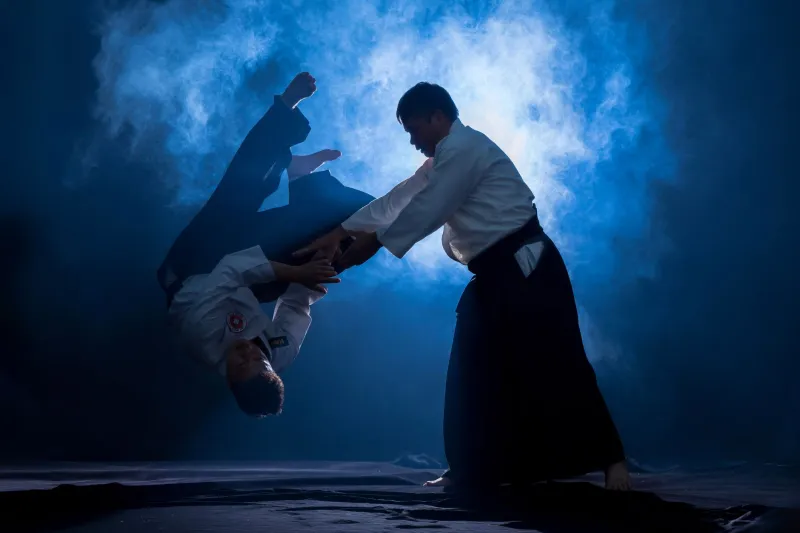
The deeper philosophical insight that aikido offers — and the one that distinguishes it most sharply from competitive combat sports — is a fundamental reorientation of what constitutes advantage. In systems built around opposition and dominance, strength, speed, and size are unambiguous assets. Aikido's technical architecture, however, is premised on the idea that force meeting force is inherently inefficient. The art is not merely tolerant of the practitioner who lacks conventional physical advantages. It is, in a meaningful sense, designed for them.
O-Sensei Morihei Ueshiba, who developed aikido in Japan in the mid-twentieth century, articulated this principle repeatedly: the art was meant to transcend the physical categories that conventional martial training privileged. His vision was of a practice that grew more effective as the practitioner aged and deepened their understanding — a direct inversion of the athletic depreciation curve that governs most physical disciplines.
American practitioners who internalize this framework do not merely cope with their limitations. They begin to regard them as specific, irreplaceable contributors to their development. The chronic knee problem that forces precise footwork. The introversion that cultivates exceptional listening. The late start that eliminates impatience. Each constraint becomes a teacher with a particular curriculum.
The Dojo as a Laboratory for Revaluation
For practitioners currently navigating what feels like a disadvantage — whether physical, psychological, or circumstantial — the practical recommendation is straightforward: name the limitation precisely, then ask what it is teaching you that you would not otherwise learn.
Experienced instructors and senior practitioners within your dojo community are an invaluable resource in this process. The accumulated wisdom of a well-established training environment includes, almost invariably, multiple examples of practitioners who transformed apparent barriers into distinctive competencies. That institutional memory is one of the most underutilized assets available to students in the early and middle stages of their training.
The path in aikido is not linear, and it is not uniform. It bends around every practitioner's particular landscape of strengths and constraints, finding its way forward through adaptation rather than override. That is not a consolation for those who feel disadvantaged. It is the art's central promise — and its most enduring proof of concept.