The Effort Trap: How Letting Go of Strain Unlocks Deeper Skill in Aikido
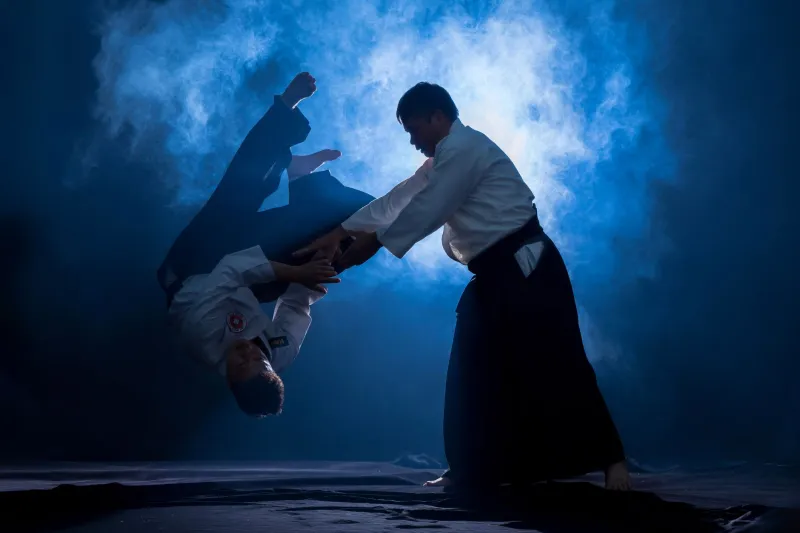
There is a particular kind of frustration that visits almost every driven American who steps onto the aikido mat for the first time. They arrive disciplined, motivated, and accustomed to the straightforward equation that has served them throughout their lives: apply more effort, receive more results. Then they attempt their first ikkyo, and the technique collapses. They try harder. It collapses again. Their training partner — relaxed, nearly effortless — executes the same movement with quiet precision.
Something is not adding up.
This is what many instructors quietly refer to as the effort trap: a pattern in which the very drive that makes a student dedicated also becomes the primary obstacle to their development. Understanding why this happens — and how to navigate out of it — requires looking honestly at the culture students bring with them, and what aikido's foundational principles are actually asking them to do.
The Hustle Culture Collision
The United States has long celebrated the grind. From early childhood, Americans are rewarded for visible effort — for raising their hands first, for staying late, for pushing through discomfort. Phrases like "no pain, no gain" and "outwork everyone in the room" are embedded in sports culture, professional culture, and increasingly in the fitness world through high-intensity training methodologies.
This orientation produces real results in many domains. But aikido operates on a fundamentally different model of skill acquisition, and the collision between hustle culture and the art's core principles is not merely philosophical — it is neurological.
When a practitioner forces a technique, they typically over-recruit muscle groups, tighten the shoulders, and narrow their attentional field. This muscular bracing, while intuitive under pressure, disrupts the very sensitivity that aikido requires. The art depends on reading a partner's balance, redirecting momentum, and moving in coordination with force rather than against it. Tension in the practitioner's own body creates noise that drowns out the subtle information the technique depends on.
In short, trying harder produces the opposite of what the student intends.
What the Nervous System Actually Needs
Sports neuroscience has increasingly validated what aikido teachers have understood for generations. Research into motor learning consistently demonstrates that a state of relaxed attentiveness — sometimes described as a low-arousal focus — supports faster skill acquisition than high-arousal, effortful concentration. When the nervous system is calm, it is better positioned to detect and respond to incoming sensory information. When it is braced for impact, it is primarily in a defensive posture that limits adaptability.
This is why experienced practitioners often describe effective technique as feeling almost accidental — as if the movement happened through them rather than by them. That description is not mysticism. It reflects a nervous system operating efficiently, without the interference of excessive muscular tension or anxious self-monitoring.
Sensei Patricia Hollis, who has taught in the Pacific Northwest for over two decades, describes this phenomenon with practical clarity: "The students who improve fastest are almost never the most intense ones in the room. They're the ones who become genuinely curious about what relaxation actually feels like in their body. The intense ones spend months fighting themselves before they figure out that the fight is the problem."
Reframing What Progress Looks Like
For practitioners raised on measurable milestones — times, weights, ranks, certifications — aikido presents an unusual challenge: progress is often invisible from the outside, and sometimes feels like regression from the inside.
A student who spends several months genuinely softening their grip, slowing down, and abandoning the habit of muscling through a technique may feel as though they are going backward. Their techniques may briefly become less reliable as familiar compensations are removed. This phase, which instructors sometimes call the dissolution period, is actually a sign of meaningful development. The student is dismantling an inefficient movement pattern before constructing a more capable one.
The difficulty is that this process requires a kind of faith that runs counter to American productivity instincts. There is no immediate feedback loop, no dashboard showing improvement. Progress is sensed, not measured — and learning to trust that sensation is itself a significant part of the training.
Instructor Marcus Webb, who teaches at a dojo in the Chicago area and works extensively with professionals in high-performance careers, has observed this pattern across hundreds of students. "The engineers and the executives are often the hardest cases," he notes, with evident affection. "They want to optimize. They want a protocol. And the honest answer is that the protocol is: stop optimizing. Pay attention. Let it unfold. That's genuinely difficult for people who've built careers on doing the opposite."
Practical Strategies for Releasing Forced Effort
Acknowledging the problem is the first step. Moving through it requires specific practices that many instructors recommend.
Deliberate breath awareness during technique. Most practitioners unconsciously hold their breath when executing a difficult movement. Maintaining a steady, natural breath throughout practice is both a diagnostic tool — if you are holding your breath, you are almost certainly tensing unnecessarily — and a direct intervention against over-effort.
Reducing speed before adding complexity. When a technique repeatedly fails, the instinct is often to try it faster or with more force. The more productive response is to slow down significantly, almost to the point of stillness, and examine where the movement is actually breaking down. Slowing down forces the practitioner to feel what is happening rather than power through it.
Shifting attention from outcome to sensation. Rather than monitoring whether the technique is "working," practitioners benefit from directing awareness inward — to the quality of contact with their partner, the position of their own center, the distribution of their weight. This attentional shift reduces performance anxiety and increases the sensory information available for real-time adjustment.
Training with partners of varying experience levels. Working regularly with more experienced practitioners — who will not accommodate forced technique — reveals the effort trap quickly and honestly. Working with newer students, meanwhile, requires the more advanced practitioner to develop sensitivity and precision rather than relying on experience to overpower.
The Paradox as a Teaching Tool
What makes this dimension of aikido training genuinely profound is that the paradox does not disappear at advanced levels — it deepens. Senior practitioners are not people who have finally learned to try hard in the right way. They are people who have internalized a fundamentally different relationship with effort itself.
The art, in this sense, is not merely teaching self-defense or physical coordination. It is cultivating a capacity to remain present and responsive under conditions that would typically trigger bracing, forcing, and contraction. That capacity, once developed on the mat, tends to migrate into other areas of life — into difficult conversations, high-stakes decisions, and moments of personal or professional pressure.
For American practitioners accustomed to measuring their worth through visible striving, this reorientation can feel genuinely disorienting at first. Many describe it, in retrospect, as one of the most valuable things the training gave them.
The mat, it turns out, is an unusually effective place to learn that some of the most important things in life cannot be forced — only allowed.