Go Slow to Move Fast: The Neuroscience Behind Deliberate Aikido Practice and Explosive Real-World Response
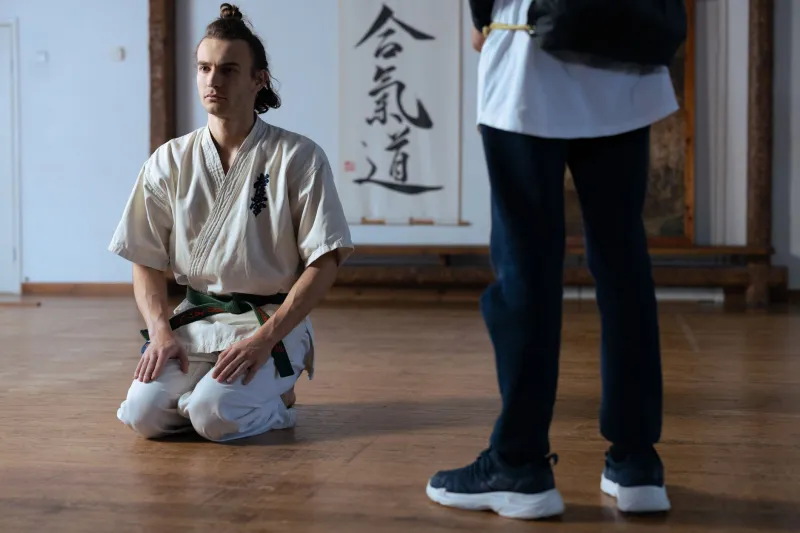
Walk into almost any aikido dojo on a Tuesday evening and you will witness something that strikes the uninitiated as puzzling. Practitioners move through techniques at a pace that looks almost meditative — unhurried entries, patient redirections, movements that seem more choreographed than combative. A visitor accustomed to the rapid-fire exchanges of boxing or the explosive drilling of mixed martial arts might reasonably wonder whether any of this translates to a real confrontation. The answer, supported by a growing body of motor learning research and confirmed by practitioners who have tested these skills under pressure, is a resounding yes — and the mechanism behind that translation is more fascinating than most people expect.
The Myth of Speed Training
Popular culture has long promoted the idea that you fight the way you train. The logical extension of that belief is that training fast produces fast fighters. Speed-focused martial arts spend considerable time drilling at or near full intensity, on the assumption that the nervous system must be conditioned to operate at competition velocity. There is genuine merit to this approach for certain athletic contexts. However, it rests on an incomplete understanding of how the brain encodes and retrieves motor patterns under stress.
Researchers in motor learning science have identified a phenomenon sometimes called the speed-accuracy trade-off: as movement speed increases during the acquisition phase of a new skill, error rates climb sharply and the quality of neural encoding degrades. In plain terms, practicing a technique quickly before it is properly internalized does not teach speed — it teaches sloppy approximations of the correct movement, repeated at high velocity. The nervous system stores what it actually does, not what it intends to do.
How Aikido's Deliberate Pace Encodes Precision
Aikido's traditional emphasis on controlled, measured repetition is not a relic of an older, gentler era. It is, whether its founders articulated it in these terms or not, a sophisticated application of what neuroscientists now call deliberate practice — the kind of focused, error-conscious repetition that produces the deepest and most durable motor engrams in the brain.
When a practitioner executes irimi-nage or kote-gaeshi slowly, the prefrontal cortex remains actively involved. The practitioner can feel where the balance point shifts, sense the precise moment of kuzushi, and make micro-corrections in real time. Each repetition deposits a cleaner, more detailed neural blueprint. Over thousands of such repetitions, the movement migrates from conscious deliberation toward the basal ganglia and cerebellum — the brain's deep motor archives — where it becomes automatic and extraordinarily fast to retrieve.
The paradox resolves itself here: slow training is not slow performance. It is the most reliable method for building the neural infrastructure that enables fast performance.
Threat Response and the Autonomic Nervous System
Understanding why aikido practitioners often respond effectively under genuine threat requires a brief look at what happens physiologically when danger appears. The amygdala triggers a cascade of stress hormones within milliseconds of perceiving a threat. Heart rate surges, fine motor control degrades, and the prefrontal cortex — the seat of conscious, deliberate thought — is effectively sidelined. Techniques that depend on conscious decision-making or complex sequences initiated under cognitive control become unreliable.
What does not degrade under this autonomic storm is deeply encoded procedural memory. Skills that have been driven into the cerebellum through extensive, high-quality repetition are accessible even when the thinking brain is flooded with cortisol. This is precisely the category into which well-trained aikido technique falls. The practitioner does not need to think about the entry or the redirection. The body has rehearsed the pattern so thoroughly, at such a precise level of detail, that the response emerges before conscious thought can intervene.
By contrast, techniques drilled primarily at high speed — where neural encoding is noisier and less precise — are more vulnerable to degradation under stress. The body retrieves a blurrier version of the movement, and the result is often hesitation or mechanical failure at the worst possible moment.
Awareness as a Force Multiplier
Aikido's deliberate pace serves a second, equally important function: it cultivates the quality of attention that practitioners call zanshin — a sustained, receptive awareness that extends before and after each technique. Training slowly allows practitioners to develop sensitivity to the full arc of an interaction, not merely its peak moment of contact.
This perceptual training has measurable consequences. Studies on expert-novice differences in reactive sports consistently find that experts do not simply move faster — they perceive earlier. They detect the earliest available cues, whether a subtle weight shift, a change in an opponent's gaze, or a micro-tension in the grabbing hand, and begin their response before the threat has fully materialized. Aikido's slow, attentive drilling builds exactly this kind of anticipatory perception, compressing the effective reaction time without requiring the practitioner to move at superhuman speed.
Sensei Carol Hagen, who has taught aikido in the Pacific Northwest for over two decades, describes it this way: "My students who have been training for five or more years don't look like they're reacting. They look like they already knew what was coming. That's not magic — that's what happens when you spend years paying close attention to the beginning of things."
Practical Implications for American Practitioners
For practitioners training in dojos across the United States, this understanding carries concrete implications for how to approach each session. The temptation to rush through repetitions — to feel productive by accumulating volume at the expense of quality — is one of the most common and costly errors in any training environment. Aikido's traditional structure actively resists this temptation, and practitioners would do well to appreciate that resistance rather than chafe against it.
Beginners in particular benefit from embracing the slow pace rather than treating it as a limitation to be outgrown. Every unhurried repetition is a deposit into a neural account that will pay dividends years down the line. Intermediate practitioners who feel the pull toward faster, more dynamic training should consider that speed, introduced before the foundational pattern is truly clean, may actually erode the precision they have worked to build.
Advanced students and instructors carry a responsibility to model this understanding for newer practitioners, making explicit what the slow work is actually accomplishing at the level of the nervous system.
The Long Game
Aikido has always been, at its core, an art of the long view. Its founder, Morihei Ueshiba, spoke of training as a lifelong process of refinement rather than a sprint toward competitive readiness. Modern neuroscience has arrived, by a very different route, at a remarkably similar conclusion: the most durable, most reliable, and ultimately fastest physical intelligence is built through patient, precise, and deeply attentive practice.
The practitioner who spends years moving slowly through the forms is not sacrificing speed. They are building something that speed-first training rarely achieves — a nervous system so thoroughly educated in the geometry of conflict that it can navigate genuine danger not by outrunning it, but by already being in the right place before the threat fully arrives.
In that sense, the apparent paradox of aikido dissolves entirely. Slow is not the opposite of fast. Slow, practiced with full attention and genuine commitment, is how fast is made.